The price tag is dead. That number flashing on your screen when you buy something online isn’t tied to what the product costs to make anymore. It’s a number built for one person. You.
This isn’t about inflation. It isn’t ordinary corporate greed, or the fact that two shoppers sometimes see two different prices. That’s the surface. What’s actually happening has a name — surveillance pricing — and what it’s built to do is worse than skimming a few hundred rupees off you here and there.
Its real job is total salary extraction.
Amazon, Google, Meta, Apple, Netflix — call them what you want, cartel is the right word — don’t just run the internet anymore. They run your economic life. Between the AI, the device tracking, the permissions you clicked “allow” on inside some finance app, and years of purchase history, they know what you earn, what you owe, what your kids need, and what’s sitting in your account right now, this second.
They’re not pricing a product. They’re pricing your entire month, tuned so precisely that by the time your salary date comes back around, you’re at zero again.
How Tech Cartels Track Your Bank Balance to Set Prices
Most people think surveillance pricing means two people see two different numbers for the same pair of shoes. Sure, that happens. But that’s not the real threat.
The real threat is what I’d call macro-basket pricing — they’re not pricing an item, they’re pricing your life.
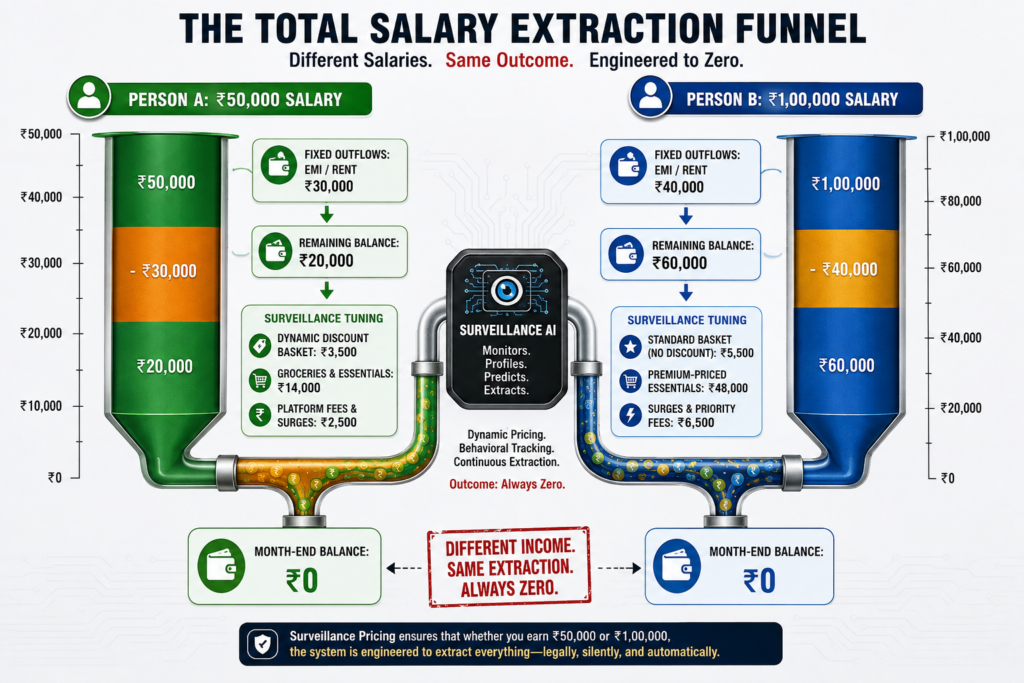
Take two people living in the same building.
- You earn ₹50,000 a month. Rent or a home loan, groceries, electricity and water, your kid’s school fees, fuel, the usual grind.
- The guy next door earns ₹1,00,000. Same building, same rent, roughly the same lifestyle needs. On paper, he should be walking away with an extra ₹50,000 in his pocket every single month.
Here’s the thing — the algorithm isn’t looking at your shopping cart item by item. It’s looking at your entire basket, every month, on repeat.
And because these companies own the search engines, the payment gateways, the e-commerce platforms, the grocery apps, the subscriptions — every single one — they can see your cash flow like an X-ray.
- For the ₹50,000 earner: the system works out your bare-minimum survival cost and quietly tunes prices — groceries, delivery fees, medicine, the streaming subscription you forgot to cancel — until it adds up to exactly ₹50,000.
- For the ₹1,00,000 earner: it spots the bigger paycheck. Discounts disappear. Convenience fees creep up. Baseline prices drift higher. Same basket, same building — priced to swallow the whole lakh.
Both of you worked the same 30 days. Both of you think you shopped smart, maybe even scored a good “deal.” And at the end of the month, both accounts read zero.
This is dynamic pricing turned into a financial siphon. It doesn’t matter what you earn — the system is built so you never get ahead. You just stay on the treadmill.
And this isn’t a stretch — it’s how the shadow data broker industry already operates today. The FTC’s own study found a single data broker holding roughly 3,000 individual data points on nearly every consumer in America (source: FreshFromCache, July 2026). A US Senate investigation found these companies quietly trading marketing lists with names like “Rural and Barely Making It” and “Credit Crunched: City Families” — categorising real people by exactly how close they are to broke (source: Fairness.io / Civil Rights, Big Data & Our Algorithmic Future). When you open an app with ₹20,000 left in your account, the system behind it isn’t seeing a customer. It’s seeing a profile, tagged and ready.
Here’s the question they don’t want you asking: prove they’re not doing it.
You can’t see the algorithm. Nobody outside a server room in Menlo Park or Seattle can. You don’t get to check the code that decides your price. You definitely don’t get access to whatever model is reading your salary credits, your EMIs, your grocery history. It’s a black box, and the same people who profit from squeezing you are the ones who built it, own it, and control every knob on it.
This isn’t just theory, either. In July 2024, the US Federal Trade Commission got suspicious enough to act on it — they issued formal orders to eight major pricing intermediaries, including Mastercard, JPMorgan Chase, and McKinsey, demanding they explain exactly how they use people’s credit history, spending patterns, and location data to quietly move prices for individuals (source: FTC official press release, July 23, 2024). That’s not a random blogger’s conspiracy theory. That’s a national regulator that decided this practice needed a formal investigation.
And it hasn’t stopped there. In December 2025, a joint investigation by Consumer Reports and two other watchdog groups exposed the scale of this so clearly that Instacart pulled the plug on its own AI pricing experiments within days of the report landing (source: Consumer Reports investigation coverage, Jan 2026). By April 2026, Maryland became the first US state to ban surveillance pricing outright for grocery and food delivery. New York now legally requires companies to disclose when a price has been personalised. In March 2026, the US House Oversight Committee opened its own investigation, writing to major travel and platform companies for their pricing algorithms and internal records (source: Faegre Drinker legal analysis, May 2026). This is a fast-moving, multi-country regulatory fight, not a fringe theory — the scary part isn’t that they’re looking into it, it’s how much damage gets done to ordinary people’s wallets while the investigation crawls along.
It’s not just a Western problem either. India’s own Competition Commission flagged this exact risk in its 2025 market study on AI and competition, naming “algorithmic cartelisation, self-preferencing, and price discrimination” as live concerns in India’s digital markets (source: CCI AI & Competition market study analysis). The same year, the CCI notified new Cost of Production regulations specifically built to catch exploitative and predatory pricing in e-commerce and quick commerce (source: Outlook Business, May 2025). And this isn’t some abstract policy debate — in March 2025, sitting Lok Sabha MPs directly asked the Union Minister for Consumer Affairs why two people booking a cab for the identical route, from the identical pickup point, were being shown different fares (source: MediaNama, March 2025). That question came from Parliament, not a Twitter thread.
So ask yourself, honestly — what’s actually stopping the cartels from doing exactly what that FTC inquiry is looking into, right here, on you?
Not the law. India doesn’t have anything on the books that bans this. Not competition — they are the competition, on every platform you’d use to check. Not conscience — a public company’s entire job is to grow shareholder returns, and a system that quietly drains a billion people to zero every month is, without exaggeration, the most efficient revenue engine ever designed. The only thing standing between you and total extraction is trust. And they’re asking you to trust a black box that has never once been opened to prove it isn’t doing exactly what it’s incentivized to do.
They’ll dress it up. “Personalized offers.” “AI-driven discounts.” “Smart pricing.” Fine — open the model, then. Publish the logic. Let an independent auditor sit down and show the public what’s actually deciding your grocery bill this month.
They won’t. Because they can’t. The day that box opens, “coincidence” stops being a word anyone believes.
The Illusion of the Free Market
Go back to basic economics for a second. For centuries, prices moved because of real supply and real demand. A bad harvest, vegetable prices go up. A factory overproduces, prices fall. Petrol gets expensive, people drive less, demand cools, prices settle back down.
The one rule that made all of that fair was simple: the market doesn’t know who you are. It’s blind.
Elon Musk walks into a Walmart to buy a TV. I walk in right behind him. We pay the same price. Gautam Adani pulls up to a petrol pump — he pays the same rate per litre as everyone else in the queue. Real economics only cares about supply and demand in aggregate. It has no idea what’s in your bank account. Petrol doesn’t check whose tank it’s filling. Surveillance pricing throws all of that out. This is dynamic pricing vs. surveillance pricing, and the difference matters: dynamic pricing responds to supply, demand, time of day, inventory. Surveillance pricing responds to you — your salary, your balance, how desperate you are for what’s in your cart right now. The price stops being about the product. It becomes about what’s left in your account.
The Unchecked Power of the Tech Cartel
If any of this sounds far-fetched, look at what these companies have already gotten away with — against a sovereign government, in plain sight.
Take what happened with Meta. On July 23, 2026, right in the middle of the CJP-led student protests over the NEET paper leaks, the Prime Minister of India posted his first-ever direct, selfie-style video, speaking straight to Gen Z. It blew up — over 300 million views in 24 hours, on an account with more than 100 million followers.
Five days later, on July 28, Meta restricted access to it. No warning. No real explanation (source: BusinessToday, July 28, 2026).
A foreign company sitting in California pulled the single most-watched piece of content the Prime Minister’s office had ever put out — mid-crisis — and offered nothing.
Ask yourself how a “technical glitch” lands on exactly that video, at exactly that moment. When the government wants unlawful content taken down, Meta needs a court order or a formal notice, and then a legal clock starts — three hours for most flagged content, two for the worst of it. Written orders. Legal deadlines. A paper trail.
But when Meta’s own system pulled the Prime Minister’s own record-breaking post? No court order. No notice. Just a “glitch,” quietly restored days later.
Here’s what actually happened next — not what could’ve happened, what did. The government summoned Meta’s global head of public policy. They called the explanation “not adequate” and demanded more. Meta gave them one line — removed in error, since restored — and that was it. No fine. No penalty. No real accounting for how or why. The government of the world’s fifth-largest economy, responding to an attack on its own head of state’s account, couldn’t get more out of Meta than a shrug and the word “glitch.”
Sit with that for a second. If a government of 1.5 billion people can’t get a straight answer out of Meta when it’s the Prime Minister’s own account on the line, what exactly do you think happens when it’s your account? Your small business page? Your livelihood, switched off on a whim? You’re not getting a summoned meeting or a ministry statement. You’re getting a form email. If you’re lucky.
These companies don’t answer to your courts, your laws, or your democratic process. They enforce their own rules, on their own schedule, and when they’re caught, “glitch” is the word they reach for. If you think your local elected officials can save you from this, you’re kidding yourself. Outside three or four superpowers, most governments on this planet are functionally powerless against these companies — and as this incident shows, even the powerful ones don’t have much leverage either.
Controlling the Narrative: How Do You Know What Rice Actually Costs?
Ask yourself something basic. How do you actually know what a kilo of rice should cost?
₹50? Says who? Vegetables at ₹60 — based on what? Chicken at ₹300 — compared to what?
You only know because of the reference points around you. But what happens when three or four companies control both the information you see and the marketplace you spend in?
Every app you use to “compare prices” is owned by the same small cluster of cartels.
So what’s stopping them from pushing a single, unified story across your feed and your search results — global shortages, broken supply chains, the “new normal” is ₹200 rice, ₹300 vegetables, ₹1,000 Chicken?
Nothing is stopping them.
They manufacture the narrative in your feed, quietly reset the baseline price across their own apps, then hand you an AI-tailored “discount” — ₹150 off that ₹50 bag of rice. You click buy, feel like you won, and never clock that you just paid double.
That’s the whole play. They write the news. They set the price. They extract the difference straight out of your income. That’s digital price manipulation in its purest form — and it works precisely because you never see the mechanism, only the “discount.”
Why the Kirana Store Is Better Than Quick Commerce
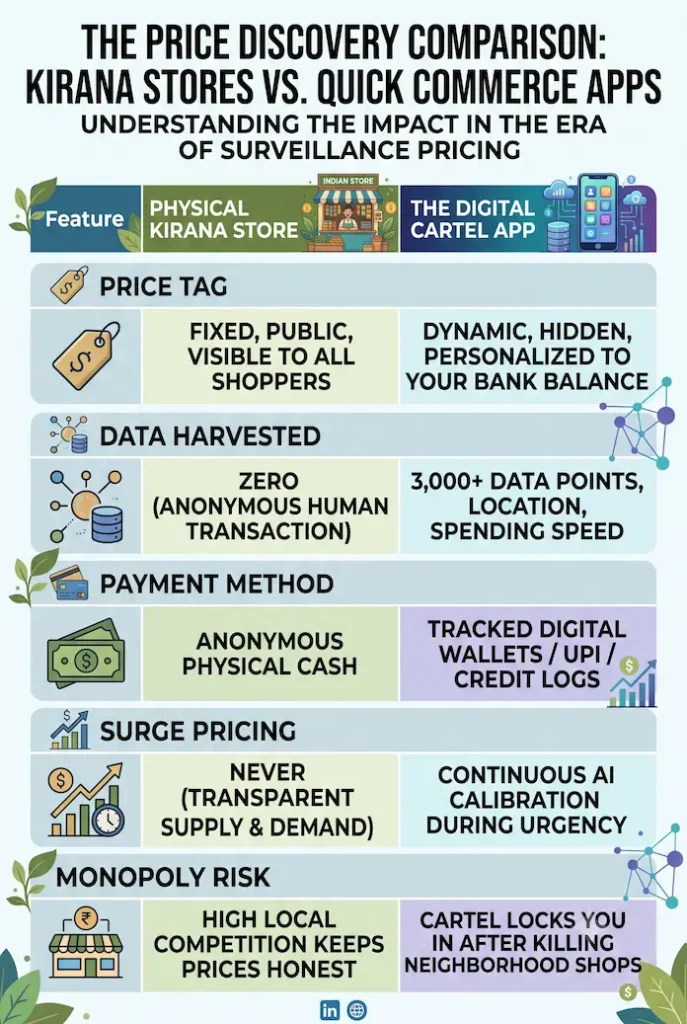
Right now, there’s exactly one thing standing between you and total digital price control: the physical, local market.
The algorithm’s biggest enemy isn’t a regulator. It’s the guy running the corner kirana store. It’s the sabzi mandi. It’s the neighbourhood butcher who knows your name. As long as you can walk down your street, look at real produce, talk to an actual human, and pay with real cash, their whole pricing illusion falls apart. The local shopkeeper is the last honest price check left in the system.
Which is exactly why the cartels have been running a slow, deliberate war against him.
- “Kirana stores are unhygienic.”
- “Local vendors shortchange you on weight.”
- “Old-fashioned, no convenience.”
- “Smart people order in ten minutes.”
And this isn’t a guess — look at the money actually being burned to make that happen. Zepto’s losses jumped 177% in FY25 to ₹3,367 crore. Swiggy Instamart lost ₹840 crore in a single quarter while opening 316 new dark stores (source: Digital in Asia, June 2026). That’s not a business trying to turn a profit. That’s a company setting cash on fire to buy market share, on purpose, because the endgame was never “make money on grocery delivery.” The endgame is: kill the kirana store, own the only benchmark left, then set the price however they like.
And it’s working. Roughly 200,000 kirana stores have shut down in the past year alone, most of them in big cities, and one estimate puts more than a quarter of India’s neighbourhood stores at risk of closing by 2030 if this keeps up (source: Rest of World, December 2024). For now, kirana stores still handle the majority of India’s grocery volume — but “for now” is doing a lot of work in that sentence, because the burn rate isn’t slowing down.
Even India’s own competition regulator has clocked the pattern. In 2025, the CCI notified new “Cost of Production” regulations specifically designed to catch predatory and exploitative pricing in e-commerce and quick commerce — a direct response to years of complaints that these platforms were pricing below cost on purpose to bankrupt local sellers (source: Outlook Business, May 2025). A regulation like that doesn’t get written for a problem that isn’t happening.
Your local shopkeeper’s supply chain was never built to survive that kind of capital assault. And don’t put it past them to get creative — companies with balance sheets that deep can absolutely afford to run a “local-style” store right outside your own gated community, prices jacked up just enough to make the algorithm’s number look normal by comparison.
Once the kirana stores are gone and every transaction runs through a screen, the trap closes for good. No street vendor left to check a price against. No cash left to keep you invisible.
At that point, you buy your basic necessities at whatever number the algorithm decides you can still afford — and you’ve got nowhere left to walk to.
The Modern Serfdom
The old formula for commerce was simple: cost of the product, plus a fair profit. Competition kept that margin honest.
That formula is dead. The new one, running quietly under every app on your phone, looks like this:
Price = Total Income in Your Account − Minimum Required for You to Survive
Regulators are starting to notice. Antitrust bodies are slowly poking at “surveillance pricing” models that harvest browsing behaviour, location history, device signals. But regulation moves at government speed, and by the time it catches up, the physical infrastructure — the kirana stores, the mandis, the cash economy — may already be gone.
And remember, these cartels know exactly what they can get away with, and exactly where. They play by the rules in three or four global superpowers and ignore everyone else, because they know the rest of the world can’t touch them.
If you doubt this, just look at the multinational food companies. Look at the ingredients they put in the food packets sold in European countries versus what they dump into Asian countries like ours. Why don’t they provide the same safe, high-quality products here? Because they know they can get away with feeding lower-quality products to lower-income nations for a higher profit margin. The tech cartels are doing the exact same thing—just with your data and your bank account instead of your food.
You might assume your government could push back the way those few superpower nations do. Go ahead—ask yourself honestly how often you actually see news of that pushback in your own social media feed. You don’t. Because these tech companies control the feed, and they make sure you never see the moments they lose. Governments alone are not going to fix this. And any official who fights them too hard risks losing the battle, or losing their seat entirely.
So What Can You Actually Do? Protecting Wealth From Tech Cartels
You’re probably not stopping this outright. Nobody reading this is going to dismantle Amazon by lunchtime. But you can slow it down, and more importantly, you can protect your own money while everyone else argues about regulation.
1. Go back to physical cash.
Every UPI scan for a ₹20 chai feeds the machine. And it’s not a small stream — India processes over 23 billion digital transactions a month now (source: NPCI data via The Tribune, June 2026). Every single one of those is a data point: where you were, what time, how much, how often. That’s not convenience. That’s 23 billion free signals a month, flowing straight into the same systems that decide your prices. A ₹500 note doesn’t report your GPS location. It doesn’t have a browsing history. It doesn’t know your credit score. Pay in cash, and for that transaction, you simply don’t exist to the algorithm.
2. Defend the local shop with your wallet.
Stop trading long-term financial freedom for ten minutes of convenience. Walk down the street. Buy your vegetables from the sabzi mandi. Buy your staples from the kirana store. Yes, it takes fifteen minutes instead of two. Yes, you have to actually talk to someone. But every rupee that goes to a local vendor stays in your own community, completely outside the extraction engine these platforms have built. You’re not just buying groceries. You’re keeping the one price benchmark alive that doesn’t answer to a server in California.
Conclusion
Every time you hand your whole life over to an app, you’re stepping into a system where the house already knows your bank balance before you’ve opened the menu. They were never selling you convenience. They were building a machine where you earn just to survive, and they take the rest.
The choice is genuinely yours here. “Convenience” is the bait. Privacy isn’t some vague, abstract idea — it’s the actual floor your financial freedom stands on. Getting it back means accepting a little friction in your day-to-day life.
Wake up and defend the physical world around you, or spend the rest of your working life feeding a system that was never built to let you win. Stop playing their game. Step outside. Pay in cash. Build assets that don’t live inside someone else’s algorithm. And take your money and life back.
About the Author : The Hard-Asset-Architect is an everyday employee who woke up to a rigged financial system. WealthDharma exists to cut through the false narratives of paper wealth and advocate for the only real escape route: physical ownership of homes, land, and gold. Every claim in this article is sourced and linked — Read the full ideology here.
Disclaimer: This article is for informational purposes only. Terms, benefits, and conditions of gold savings schemes vary by jeweller and are subject to change. Readers are advised to verify current scheme details directly with the respective jewellery brand before enrolling. For additional information, please read our full Disclaimer.