Walk past any jewellery showroom today, or scroll through social media for five minutes, and you’ll see it: glossy advertisements for 18K, 14K, and even 9K gold jewellery, marketed as “affordable,” “modern,” and “perfect for everyday wear.” On the surface, it looks like innovation. In reality, it is a quiet erosion of trust — and a troubling substitute for an honest conversation about affordability. This is what low-karat gold marketing in India has increasingly settled into: dressing up a shortage of gold as a new kind of gold.
A Problem Dressed Up as a Solution
Gold prices have climbed sharply in recent years, pricing many middle-class and working-class families out of the jewellery they once bought without a second thought — a simple chain for a daughter’s wedding, a pair of earrings for a festival, a ring passed down as a keepsake. Instead of acknowledging this honestly, parts of the jewellery industry have found a workaround: keep selling “gold,” just make it less gold.
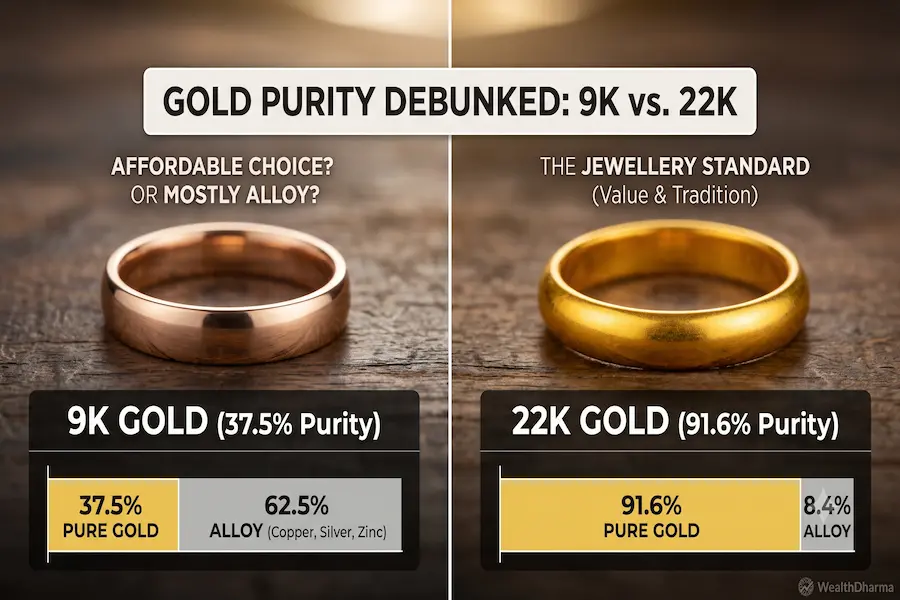
18K is 75% pure gold. 14K drops to about 58%. 9K — increasingly advertised as a trendy, budget-friendly option — is barely 37.5% gold, meaning almost two-thirds of the metal in that “gold” bangle or necklace is silver, copper, zinc, or other alloys. The word “gold” stays on the label and the advertisement. The substance behind the word quietly shrinks.
Gold Purity at a Glance
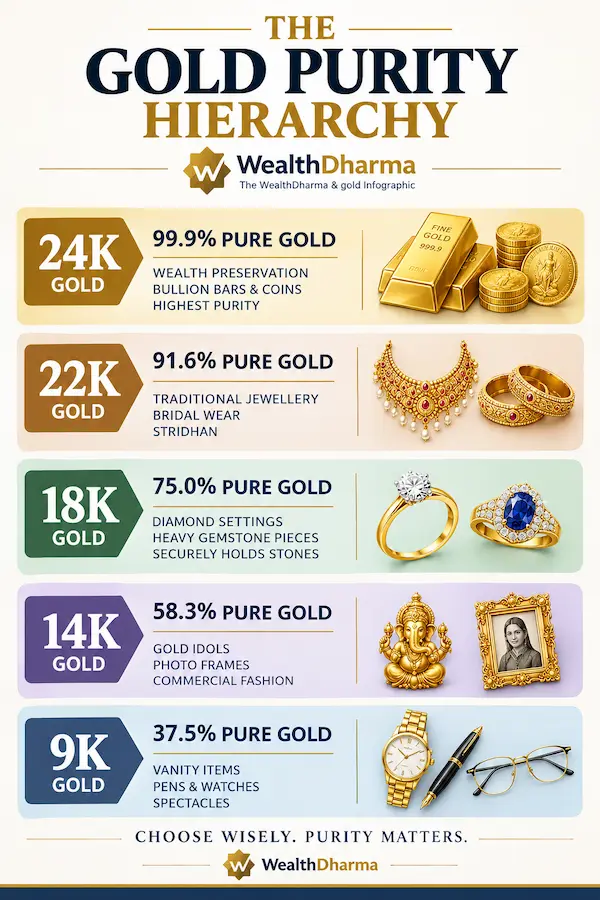
| Karat | Fineness Stamp | % Pure Gold | % Alloy | Typical Use |
| 24K | 999 | 99.9% | ~0% | Bullion, coins, investment |
| 22K | 916 | 91.6% | 8.4% | Gold Jewellery whether traditional, modern, daily wear which will become stridhan |
| 18K | 750 | 75.0% | 25% | Diamond and high value gemstone Jewellery for which 22 K Gold become unsuitable. |
| 14K | 585 | 58.3% | 41.7% | Gold idles, Puja items, Photo frames etc |
| 9K | 375 | 37.5% | 62.5% | Vanity items like Gold Pens, Spectacles, Tooth refilling etc which require more hardness while making. |
Call It What It Actually Is
There is a simple test for honest naming: whatever makes up the majority of a thing should give the thing its name. 9K gold is 9 parts gold out of 24 — meaning 15 parts, well over half, is copper and other alloy. By that logic, it isn’t “9K gold” at all. It is 15K copper. Similarly, 12 K gold, with 12 parts non-gold, is really 12K Copper Alloy — an even split where copper has just as much claim to the name as gold does, if not more once you count what actually makes the piece durable and heavy.
But no showroom, no film star, no influencer campaign will ever say “15K copper” on a billboard. They will always say “9K gold,” because “gold” sells and “copper” doesn’t. That is the heart of the deception: the name on the label is chosen for its glamour, not for what the metal actually is. If the labelling followed the same majority-metal logic used everywhere else, these pieces would be sitting in the copper aisle, not the gold one.
Why This Matters
1. It blurs an honest signal with a marketing trick. For generations, karat purity has been a straightforward, trusted signal of value. A person could walk into a shop, ask for 22K, and know roughly what they were getting for their money. Flooding the market with heavily diluted “gold” products under the same emotional branding — the same wedding-season ads, the same festive packaging — muddies that signal. People are drawn in by the word “gold” and the aspirational imagery, without always registering how little actual gold they’re paying for.
2. It exploits aspiration rather than respecting budgets. The honest, respectful path when someone cannot afford gold is simple: they buy less gold, or they buy silver instead. Silver has its own dignity — it is a real, recognized precious metal with centuries of cultural and ornamental value. If silver is still out of reach, copper jewellery is a legitimate, honest alternative, with its own craftsmanship and character.
What should not happen is an industry response that keeps people inside the “gold” category by simply hollowing out what gold means. That doesn’t expand access to gold — it repackages a non-gold product as an aspirational gold product, at a price that still trades on gold’s premium image.
3. It erodes long-term value. Jewellery, especially in many cultures, is not just an ornament — it is a store of value, often bought with the idea that it can be resold, pledged, or passed down. Heavily diluted gold resells for far less, depreciates faster in perceived value, and is harder to melt down or repurpose meaningfully. Someone buying 9K gold today, believing they are making a “smart, modern” gold purchase, may be disappointed years later to learn how little of it was ever gold at all.
4. It normalizes a race to the bottom. Once one brand markets 9K gold as a legitimate lifestyle choice, competitors follow, because the alternative — talking honestly about price, income, and affordability — is commercially harder. Over time, this shifts the entire market’s expectations downward, making genuinely high-purity gold seem like a luxury reserved only for the wealthy, rather than a standard people once trusted at any budget tier.
The Celebrity and Influencer Problem
This trend doesn’t spread on its own — it is pushed. Showroom campaigns fronted by film stars and sponsored posts by social media influencers are doing the heavy lifting of making diluted gold feel aspirational rather than diminished. A star wearing a “designer 9K collection” on a billboard, or an influencer unboxing an “affordable gold” haul on Instagram, lends emotional glamour to a product that is, by weight, mostly not gold. That endorsement is precisely what makes the substitution invisible: the audience isn’t evaluating the metal, they’re following the face. Celebrities promoting 9K gold are lending their credibility, helping normalize a lower standard, and that is worth calling out plainly — the endorsement is doing the work that an honest disclosure about purity should be doing instead.
Jewellery Has a Minimum Standard
Let’s be absolutely clear: true, wealth-preserving jewellery has a minimum standard, and that standard is 22K.
There is exactly one legitimate, mechanical exception to this rule: 18K gold, and it applies strictly and solely to diamond jewellery. Because 22K gold is physically soft, it cannot securely hold diamonds without the prongs bending and the stones falling out. If you are buying a diamond piece, dropping the purity to 18K is an engineering necessity. This 18K gold diamond jewellery exception is the only place where the compromise is legitimate — it applies only to diamonds, not to any other type of stone jewellery, and certainly not to plain gold.
If a showroom tries to sell you a plain gold chain, a traditional bangle, or a festive necklace in 14K or 9K, they are not offering you a “modern, lightweight” innovation. They are selling you heavily diluted metal. If someone wants an object made of 9K or 14K, let it be a door knob, a decorative showpiece, a pen, or a wall fitting — items where the metal’s underlying wealth retention doesn’t matter.
But hard asset jewellery — pieces meant for wearing, meant for tradition, and meant to be passed down as stridhan — is an entirely different category. It is tied to real resale value and generational security. It should never be watered down just to meet a marketing price point. For absolutely anything other than a diamond piece, this 22K minimum standard for jewellery is unshakeable. Anything sold below that is just copper and silver dressed up in a clever advertising campaign.
Here is the plain position, without hedging: low-karat gold is not jewellery-grade. If someone wants a 9K, 14K, or even 18K gold object, let it be a photo frame, a flower pot, a door knob, a decorative showpiece, a pen, a wall fitting — items bought for display or use around the house, not for wearing as an ornament of value. Jewellery is a different category altogether, tied to tradition, resale value, and personal significance, and it should not be diluted to fit a marketing price point.
Jewellery should be a minimum of 22K. That is the standard. Anything sold below that, dressed up as “jewellery,” is a lesser product wearing jewellery’s name.
Gold Jewellery Is Stridhan, Not a Consumer Product
Gold jewellery was never just another consumer purchase. In India, it was stridhan — a woman’s own wealth, meant to provide security and eventually pass from one generation to the next. It could be worn and enjoyed, but its purpose went beyond today’s appearance. The design could become old-fashioned; the gold itself remained valuable.
Today, jewellery is increasingly being marketed as fashion. New collections and designs appear constantly, and styles that look attractive today can feel outdated within a few years. Clothes naturally followed this cycle: they are bought for a particular fashion, worn and eventually replaced. When jewellery begins to follow the same cycle, it starts to feel less like something a family preserves and more like something a consumer regularly updates.
The growing acceptance of 9K gold adds another dimension to this change. The issue is not simply that 9K contains less gold. When jewellery contains much less gold and is simultaneously being presented as changing fashion, the nature of the purchase begins to shift. Instead of buying wealth that can be worn, the consumer is increasingly buying a fashionable product that happens to contain gold.
That is the deeper concern. Gold jewellery was traditionally both ornament and Stridhan — wealth that could be worn, preserved and handed down. If jewellery gradually becomes just another fashion product, we risk weakening not only the gold within it, but the very idea of Stridhan that gave gold jewellery its place in the Indian family.
The Honest Approach: Buy Less Gold, Not Less Pure Gold
There is real dignity in an honest hierarchy of choice:
- If gold is affordable — buy the gold you can afford, in the quantity you can afford, at standard purity.
- If gold isn’t affordable — buy less of it. A smaller pendant. A thin chain. A single ring instead of a set.
- If even that isn’t affordable — silver is a respected, legitimate choice, not a downgrade to be ashamed of.
- If silver, too, is out of reach — copper and other affordable metals have their own beauty and craftsmanship.
What should never be normalized is disguising a quantity problem (can’t afford much gold) as a quality solution (sell less pure “gold” instead), because that dilutes the very meaning of the word “gold” for everyone, including those who can still afford the real thing. The principle is simple: buy less gold, not less pure.
In India, a woman does not earn less respect for wearing silver or copper instead of gold. Look at any puja or festival — a woman wearing gold jewellery and a woman wearing silver jewellery standing next to her receive the exact same respect. Nobody at a puja or ceremony is measured by the karat on her wrist. Respect was always about family and was never tied to the metal in the first place — it is only modern marketing that tries to make people feel otherwise, as if wearing diluted gold instead of honest silver somehow buys more dignity.
Think of it like roti at home. If there isn’t enough for two rotis, you eat one roti — you don’t mix mitti (soil) into the dough to stretch it into two. The shortage is real, and the honest response is to eat less, not to fake more by diluting what’s on the plate. Gold works the same way. If there isn’t enough money for a full 22K piece, buy a smaller 22K piece, or buy silver — you don’t dilute the gold itself and still call it “gold.”
So Why Does the Government Allow 9K Gold Jewellery?
The industry’s argument is straightforward: nobody is hiding anything. A 9K piece is stamped 375, disclosed on the bill, and priced accordingly — customers pay 9K prices for 9K gold, not 22K rates for a diluted product. That, the industry argues, is exactly how hallmarking is supposed to work: BIS recognises 9K as a voluntary grade in India alongside 14K, 18K, 22K, and 24K, so the purity stamped on the piece is real and checkable, not a marketing claim buyers have to take on faith.
This is a genuine improvement worth acknowledging. Many gold vanity items — pens, idols, photo frames, and decorative pieces — have long been made in 14K or 9K gold, because pure or high-karat gold is simply too soft to hold fine detail or structural shape. This is especially common in South India, where a wide range of gold vanity and ceremonial items are traditionally made this way. Until now, buyers of these items had little formal way to verify what they were actually getting. With 9K now covered under BIS hallmarking, a customer buying one of these pieces from a gold shop can insist on a hallmark and walk away with authenticated, legally verifiable purity — real consumer protection that didn’t exist for this category before. Lower-karat alloys are also genuinely more durable for daily handling, since pure gold is soft, and some buyers do want a hardier, cheaper “gold-look” product and are making an informed choice.
The concern here isn’t that 9K gold exists, or that it’s now hallmarked — for vanity and decorative items, that’s a real win for buyers. The concern is the marketing sleight-of-hand that leans on gold’s emotional and cultural weight to sell diluted gold as body jewellery and Stridhan, to buyers who don’t fully register the difference between “affordable gold” and “a small amount of real gold.”
Conclusion
Buying less gold is not a compromise to be marketed around — it’s an honest response to a real economic constraint. Silver and copper are not consolation prizes; they are legitimate metals with their own long histories in jewellery-making. What the industry owes its customers is transparency, not a diluted product wearing gold’s name and gold’s advertising, sold to people who deserve to know exactly what they’re paying for.
Frequently Asked Questions
Is 9K gold real gold?
Yes. 9K gold is a genuine gold alloy containing 37.5% pure gold, with the remaining 62.5% made up of other metals. It is commonly identified by the 375 fineness mark. The issue is not whether 9K contains gold, but whether it should be treated in the same way as traditional high-purity gold jewellery.
Is 22K gold better than 9K gold for jewellery?
For traditional gold jewellery intended to retain value and be passed down as Stridhan, 22K gold provides substantially more gold content than 9K. 9K is harder and can be cheaper, but it contains only 37.5% gold compared with 91.6% in 22K. The right choice therefore depends on whether you are buying jewellery primarily as fashion or as a form of family wealth.
Why is 18K gold commonly used for diamond jewellery?
18K gold is commonly used for diamond jewellery because it provides greater hardness than 22K gold while still containing 75% gold. This can help provide the structural strength needed to hold diamonds securely. This is different from choosing a lower karat simply to make ordinary gold jewellery cheaper.
Should I buy less 22K gold instead of buying 9K gold?
If your purpose is to buy gold jewellery as long-term family wealth or Stridhan, buying a smaller quantity of 22K gold is a more consistent approach. A smaller 22K chain, pendant or bangle preserves the higher gold purity, while choosing 9K gives you a larger-looking piece with substantially less actual gold.
Why is gold jewellery considered Stridhan in Indian households?
Gold jewellery given at marriage is traditionally regarded as a woman’s personal wealth — Stridhan — meant to be passed down through generations rather than treated as an ordinary consumer purchase. This is part of why purity and resale value matter more for jewellery than for decorative gold-plated items.
About the Author : The Hard-Asset-Architect is an everyday employee who woke up to a rigged financial system. WealthDharma exists to cut through the false narratives of paper wealth and advocate for the only real escape route: physical ownership of homes, land, and gold. Every claim in this article is sourced and linked — Read the full ideology here.
Disclaimer: This article is for informational purposes only. Terms, benefits, and conditions of gold savings schemes vary by jeweller and are subject to change. Readers are advised to verify current scheme details directly with the respective jewellery brand before enrolling. For additional information, please read our full Disclaimer.