Introduction
Walk into almost any jewellery showroom in India — Tanishq, Kalyan, Malabar, Joyalukkas, or your neighbourhood family jeweller — and you’ll likely be offered a “gold scheme.” Pay a fixed amount every month for 10 or 11 months, and the jeweller adds a bonus (often a discount equal to one instalment) so you can buy jewellery for less than you’d otherwise pay.
But before you start depositing your money, you have to ask: is jewellery gold scheme a good investment? Here’s the one idea this entire guide is built around, because it’s the one most people get wrong: a jewellery gold scheme is a way to buy gold — it is not an investment option. It’s a prepaid purchase plan, not a financial asset.
Confusing the two is exactly how people end up disappointed by something that was never designed to behave like an SGB, a gold ETF, or a recurring deposit in the first place. Once you accept that framing, every feature of these schemes — the jewellery-only redemption, the lack of cash exit, the absence of RBI/SEBI oversight — starts to make complete sense.
This guide breaks down exactly how these schemes work, what they cost you, whether they’re legal, and how they compare to genuine gold investment routes like Sovereign Gold Bonds (SGBs), gold ETFs, and digital gold.
Key Takeaways
Structurally limited to 11 months: Schemes are legally capped at 365 days to classify as an “advance for goods.” Going beyond that makes them an illegal, unregulated deposit.
It’s a purchase plan, not an asset: Gold schemes are designed to help you save up for a specific piece of jewellery, not to grow your wealth or track the market price of gold.
Zero cash liquidity: You cannot withdraw your deposits as cash. Your money is locked into the jeweller and can only be redeemed as physical jewellery.
GST and Making Charges still apply: The “bonus” you receive is often partially offset by standard making charges and the mandatory 3% GST applied to the final jewellery purchase.
What Is a Jewellery Gold Scheme?
A jewellery gold scheme (also called a gold saving scheme or gold deposit scheme) is a prepaid jewellery purchase plan run directly by a jeweller — not a financial product. You commit to depositing a fixed sum every month for a set tenure — almost always 10, 11, or occasionally 12 months. At the end of the term, the accumulated amount, plus a bonus contributed by the jeweller, becomes your budget to buy jewellery at that store.
It’s worth being precise about what this is and isn’t, because the marketing language (“scheme,” “bonus,” “returns”) borrows heavily from investment vocabulary while the product itself works nothing like an investment:
| It is… | It is not… |
| A prepaid, disciplined way to buy gold jewellery | An investment product regulated by SEBI or RBI |
| A merchant-funded discount on your purchase | Interest, dividends, or capital appreciation |
| Redeemable only as jewellery at that jeweller | Redeemable as cash, like a deposit or bond |
| A savings-for-a-purchase tool | A way to build or diversify a gold investment portfolio |
Think of it the way you’d think of a layaway or instalment purchase plan with a loyalty bonus attached — not a recurring deposit, not a bond, and not a mutual fund SIP. The “gold” in a gold scheme refers to what you’ll eventually buy, not to any gold-linked financial return you’re earning in the meantime.
How Jewellery Gold Schemes Actually Work
The mechanics are fairly consistent across brands, with variations in tenure and bonus percentage:
- Enrolment: You sign up at a showroom or online with KYC documents (PAN, Aadhaar, or Voter ID).
- Fixed monthly installment: You choose an amount — typically starting around ₹1,000–₹2,000 — and commit to paying it every month for the scheme’s tenure.
- Grace period: Most schemes allow a short grace window (commonly around a week) if you miss a due date.
- Maturity bonus: At the end of the tenure, the jeweller adds a bonus — commonly structured as a discount equal to one month’s installment (effectively an ~8–10% “return” if the scheme runs 10–11 months), though the exact structure varies by brand and by year.
- Alternative Bonus Structure (Making Charge Discounts): Instead of adding a free instalment, some jewellers structure their scheme around a reduction in making charges. Depending on the brand, you might be offered a flat 50% discount on making charges, or a complete waiver up to a certain percentage (e.g., up to 18% of the making charges). This can actually be very lucrative if you plan to buy intricately designed jewellery (like antique or bridal wear) where making charges are typically very high.
- Redemption: You use the total accumulated value (your deposits + bonus) to buy jewellery at current gold rates, generally within a fixed window after maturity (often 30–90 extra days).
- No cash refund: In almost all cases, you cannot withdraw the money as cash — only as jewellery, and usually only from that jeweller’s stores.
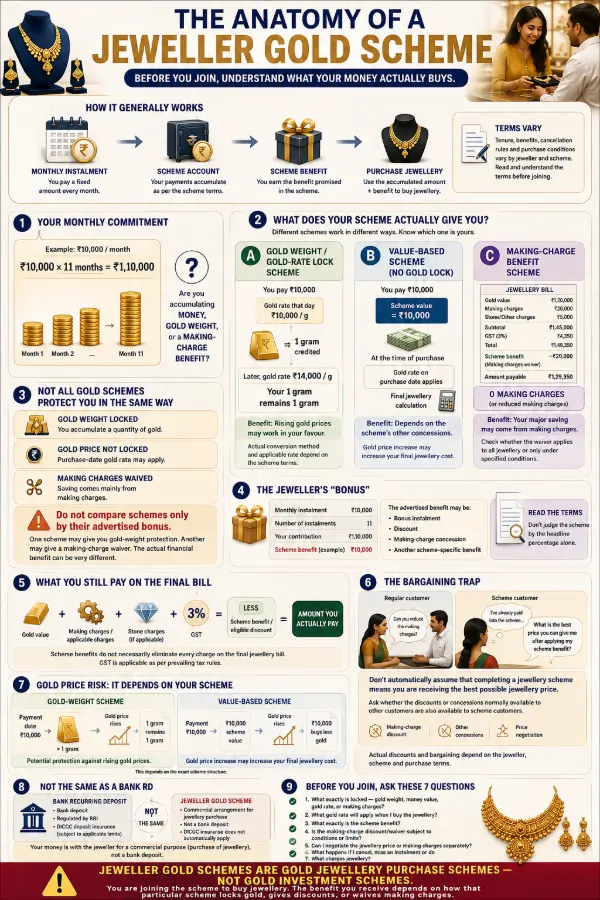
Why Schemes Are Almost Always 10–11 Months, Never Longer
This isn’t a coincidence — it’s a legal workaround. Under the Companies (Acceptance of Deposits) Rules, 2014, any advance a company collects from customers is treated as a “deposit” — which only banks, NBFCs, and specific eligible companies are allowed to accept — unless the advance is adjusted against delivery of goods within 365 days. That’s precisely why jewellers cap their schemes at 10 or 11 months: staying under the 365-day mark lets them legally collect monthly instalments as “advance for goods” rather than as a regulated deposit. Go beyond 365 days, and the scheme risks being reclassified as an illegal deposit under the Companies Act and the Banning of Unregulated Deposit Schemes (BUDS) Act, 2019 — this is also why you’ll almost never find a jeweller offering a 2-year or 3-year gold scheme.
Not all gold jewellery schemes work the same way. Before joining one, understand the different types of gold jewellery schemes and how each one benefits you.
Popular Jewellery Gold Schemes Compared
Here’s how some of India’s best-known schemes are structured. (Exact terms change periodically — always verify current terms on the brand’s official page or in-store before enrolling.)
| Jeweller | Scheme Name | Typical Tenure | Minimum Instalment | Bonus Structure |
| Tanishq | Golden Harvest | 10 months (redeemable up to ~400 days from enrolment) | ₹2,000 (multiples of ₹1,000 thereafter) | Discount of up to 75% of the first month’s instalment value, applied at redemption |
| Kalyan Jewellers | Various monthly gold plans | ~11 months | Varies by plan | Jeweller-added bonus instalment, terms vary by scheme |
| Malabar Gold & Diamonds | Gold monthly schemes | ~11 months | Varies by plan | Bonus/discount at maturity |
| Joyalukkas | Easy Gold Scheme | ~11 months | Varies by plan | Bonus instalment or discount |
| Senco Gold | Flexi/monthly plans | ~11 months | Varies by plan | Bonus instalment or discount |
The common thread: ~10–11 month tenure, monthly fixed instalments, and a bonus redeemable only as jewellery. Always check the current official terms for the specific brand and city, since bonus percentages and minimum amounts are revised periodically and can vary by store.
Is Jewellery Gold Scheme an Investment? Here’s the Real Answer
No — and this is worth stating plainly rather than hedging. A jewellery gold scheme is a purchase-planning tool, not an investment, for one structural reason: your money only ever converts back into jewellery, never into cash or a tradeable financial asset. Investments, by definition, need an exit route where you can realise value independent of a single seller. Gold schemes don’t offer that.
That doesn’t make them bad — it makes them the wrong tool if you’re asking the wrong question. So the real question isn’t “is this a good investment,” it’s “is this a good way to buy the jewellery I was going to buy anyway?” Answered that way:
If you were already planning to buy jewellery from that specific store, a gold scheme is usually a genuinely good deal. You get disciplined monthly saving plus a bonus (often effectively 8–10%+ on your total contribution) that you wouldn’t get by simply saving the cash yourself and buying jewellery later at full price.
If you’re evaluating it as an investment alongside SGBs, gold ETFs, or an RD, it will always come up short — not because the jeweller is dishonest, but because it isn’t built to compete in that category at all:
- No cash option: You cannot exit with money — only jewellery. If your life circumstances change and you no longer want jewellery, your capital is stuck.
- You’re locked into one jeweller’s design catalog: You cannot shop around for better making charges, purity, or—most importantly—designs at redemption. Every jewellery brand has its own distinct design language. For instance, one store might specialize in lightweight modern wear, while another specializes in heavy, traditional temple jewellery. Always check the store’s designs before enrolling. If you save up for 11 months only to realize you don’t actually like any of their designs, your money is still trapped there. You’ll be forced to buy something you don’t love just to redeem your accumulated funds.
- Making charges and GST still apply: The “bonus” typically offsets making charges or adds to your purchase value — it usually does not mean you get jewellery for free. More importantly, a flat 3% GST applies to your final jewellery bill. In many cases, the GST tax alone eats up a significant chunk of the “bonus” you just earned.
- No protection if the jeweller shuts down: Unlike a bank deposit (protected by DICGC insurance up to ₹5 lakh) or an SGB (a sovereign, RBI-backed instrument), a gold scheme is an unsecured commercial arrangement. If the jeweller becomes insolvent, you are an unsecured creditor with no guaranteed recovery.
- Your “return” tracks a discount, not gold’s price: You’re not building gold price exposure — you’re prepaying for a specific future purchase with a merchant-funded discount attached to it.
If you want to know whether buying ornaments will actually give you good returns or just drain your capital through making charges, read our article: Is gold jewellery a good investment.
The Legal and Regulatory Status of Gold Schemes
This is the part most articles skip — and it’s the part readers genuinely worry about.
Are jeweller gold schemes legal? Yes, when structured correctly. As explained above, jewellers structure these schemes to fall under the “advance for supply of goods” exemption in the Companies (Acceptance of Deposits) Rules, 2014, which excludes them from the definition of a “deposit” as long as gold/jewellery is delivered within 365 days of the first instalment.
Are they regulated by RBI or SEBI? Not directly, and this is a key distinction:
- RBI-regulated gold products include the Gold Monetisation Scheme and (formerly) Sovereign Gold Bonds — these are genuine RBI-backed instruments.
- SEBI has, in the past, examined whether pooled gold-linked schemes qualify as Collective Investment Schemes (CIS), which would require SEBI registration. Most compliant jeweller schemes avoid CIS classification by structuring the arrangement purely as an advance-for-goods purchase plan rather than a pooled investment with promised returns.
- If a scheme runs longer than 365 days, promises a cash return or interest, or otherwise resembles a deposit-taking or pooled-investment arrangement, it can fall foul of the Companies Act, the BUDS Act, 2019, and SEBI’s CIS Regulations — all of which carry serious penalties for the company, including imprisonment for those responsible.
Practical takeaway: Before enrolling, verify that the scheme’s tenure doesn’t exceed 12 months, that the jeweller is a reputed, established brand (or a longstanding local business with strong reputation), and that all terms are provided in writing.
Gold Scheme vs Gold Investment: A Direct Comparison
| Feature | Jeweller Gold Scheme | Sovereign Gold Bond (SGB)* | Gold ETF | Digital Gold |
| Regulator | Largely unregulated (structured as advance-for-goods) | RBI / Government of India | SEBI | Largely unregulated |
| Cash exit | No — jewellery only | Yes | Yes | Yes |
| Interest/ returns | Discount/bonus, redeemable as jewellery only | Fixed annual interest + gold price appreciation | Tracks gold price; no separate interest | Tracks gold price; no separate interest |
| Safety of principal | Unsecured; depends on jeweller’s solvency | Sovereign-backed | Backed by physical gold held by custodian, SEBI-regulated | Backed by the platform’s gold vaulting partner |
| Making charges | Usually still applicable on jewellery bought | Not applicable (not physical jewellery) | Not applicable | Not applicable |
| Ideal for | Someone planning to buy jewellery anyway | Someone wanting gold price exposure + guaranteed interest | Someone wanting liquid, tradeable gold exposure | Small, flexible gold purchases |
- Note: Fresh SGB tranches have not been issued regularly in recent cycles — check current government issuance status before assuming availability.
Bottom line: If your goal is genuinely to invest in gold as an asset class, SGBs (when available) or gold ETFs are structurally better — they’re liquid, regulated, and don’t tie you to one merchant. If your goal is specifically to buy jewellery in the near future and you want a disciplined way to save for it with a bonus attached, a reputable jeweller’s gold scheme can be a reasonable, low-friction option.
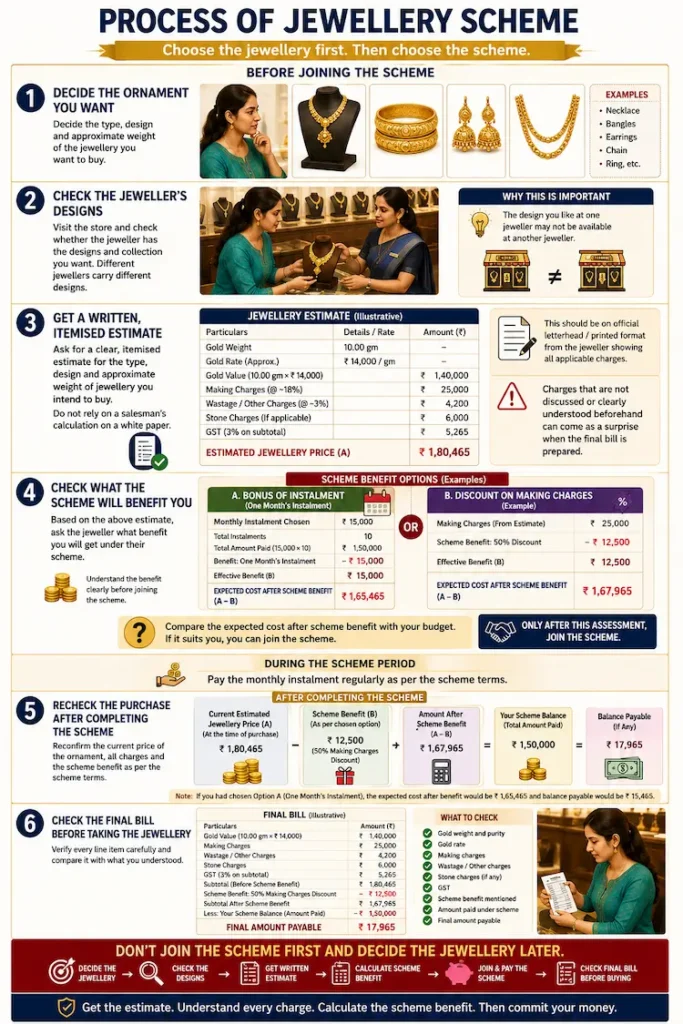
A Pro-Tip Before Enrolling: The “Mock Estimate” Test
When you walk into a showroom to ask about a gold scheme, the sales representative will usually pull out a calculator and a blank sheet of paper to explain the math. While the hypothetical numbers always look fantastic on paper, they rarely paint the full picture of your final checkout price.
Do not rely on the calculator math. Instead, walk around the store, pick out a specific ornament you actually like, and ask the representative for a standard billing estimate today. Once you have that estimate (complete with making charges, stone charges, and 3% GST), ask the representative to calculate exactly what your final out-of-pocket cost would be if you were redeeming a matured gold scheme against that specific piece.
This “mock estimate” test immediately exposes any hidden conditions, reveals exactly how the discount is applied to the making charges, and shows you the true value of the scheme in a real-world scenario.
Every piece of retail jewellery include making charges, which varies significantly depending on the design, complexity and the showroom. Before finalizing a purchase, read our detailed article to Understand how jewellery making charges work so you can make an informative decision.
Risks and Red Flags to Watch For
- Unusually long tenures (beyond 12 months) or schemes promising fixed cash interest — a major red flag suggesting non-compliance with deposit rules.
- Vague or verbal-only terms — insist on a printed passbook/certificate with all terms.
- No redemption window flexibility — check how long after maturity you have to redeem before losing the bonus.
- Small, unbranded jewellers with no track record — the biggest real-world risk isn’t fraud from large listed brands, but a small shop shutting down or the owner becoming untraceable. Several such cases have been reported across India over the years, often involving smaller local jewellers rather than large chains.
- Ambiguity on making charges — always ask explicitly whether the maturity bonus is on top of or inclusive of making charges.
Conclusion
The single most useful thing to remember about jewellery gold schemes is this: they are a way to buy gold, not a way to invest in gold. Judged as a purchase-planning tool — for someone who was going to buy jewellery from that store regardless — a reputable scheme is a perfectly sensible, disciplined way to save, often with a genuine bonus attached. Judged as an investment against SGBs, gold ETFs, or even a plain recurring deposit, it fails on nearly every count that matters: no cash exit, no regulator backing, no protection if the jeweller shuts down, and a return that’s tied to a discount rather than gold’s price.
So keep the two goals separate. Use a jewellery gold scheme, from a reputable brand with a tenure safely within 365 days, when your goal is genuinely to buy jewellery. Use SGBs, gold ETFs, or gold mutual funds when your goal is to build gold as part of your investment portfolio. Don’t let one product try to do both jobs.
This article is for informational purposes only and does not constitute financial advice. Scheme terms, bonus percentages, and minimum instalments vary by jeweller and change periodically — always confirm current terms directly with the jeweller before enrolling.
Frequently Asked Questions
Do jewellers give interest on gold schemes?
No, not in the form of cash interest. You get a bonus or discount, redeemable only as jewellery, not as money.
Can I get cash instead of jewellery at maturity?
Almost never. Nearly all schemes explicitly disallow cash redemption — this is by design, since offering cash redemption would push the arrangement toward the legal definition of a “deposit.”
What happens if I miss an instalment?
Most schemes offer a short grace period (commonly about a week). Beyond that, policies vary — some schemes let you continue with a late fee, others may forfeit some benefits. Always check the specific scheme’s default policy before enrolling.
Is a gold scheme better than a recurring deposit (RD)?
An RD gives you a guaranteed, government-insured (via DICGC, up to ₹5 lakh) cash return with full liquidity. A gold scheme gives you a jewellery-only bonus with no deposit insurance. If you need flexibility or might not want jewellery later, an RD is safer. If you’re certain you’ll buy jewellery from that store anyway, the scheme can offer better effective value.
What happens if the jewellery shop shuts down before maturity?
You become an unsecured creditor with no automatic protection — unlike a bank deposit or SGB. This is the single biggest risk of these schemes, which is why sticking to established, reputable brands (or filing complaints promptly with consumer forums if something goes wrong) matters.
Are gold schemes a good investment for Gold exposure?
No. Since redemption is jewellery-only and making charges still apply, gold schemes are better understood as a savings-for-purchase tool rather than a gold investment vehicle. SGBs or gold ETFs are more efficient for gold investment.
About the Author The Hard-Asset-Architect is an everyday employee who woke up to a rigged financial system. WealthDharma exists to cut through the false narratives of paper wealth and advocate for the only real escape route: physical ownership of homes, land, and gold. [Read the full ideology here.]
Disclaimer: This article is intended for educational and informational purposes only. It reflects general financial principles and the author’s views on home ownership. It should not be considered legal, tax, financial, or real estate advice. Every family’s financial situation is different. Please evaluate your own circumstances and consult a qualified professional before making significant financial decisions. For additional information, please read our full Disclaimer.