Introduction: The Question We Stopped Asking
We were sold an idea. The idea was incredibly simple, highly persuasive, and seemingly flawless: if both husband and wife work, the family will inevitably have more money, greater financial security, a vastly improved lifestyle, and a much better future.
It sounds obvious on paper. Basic math dictates that two incomes must be fundamentally better than one.
But somewhere along the way in our modern economic evolution, we stopped asking a much more important, foundational question: Does every family really need two incomes?
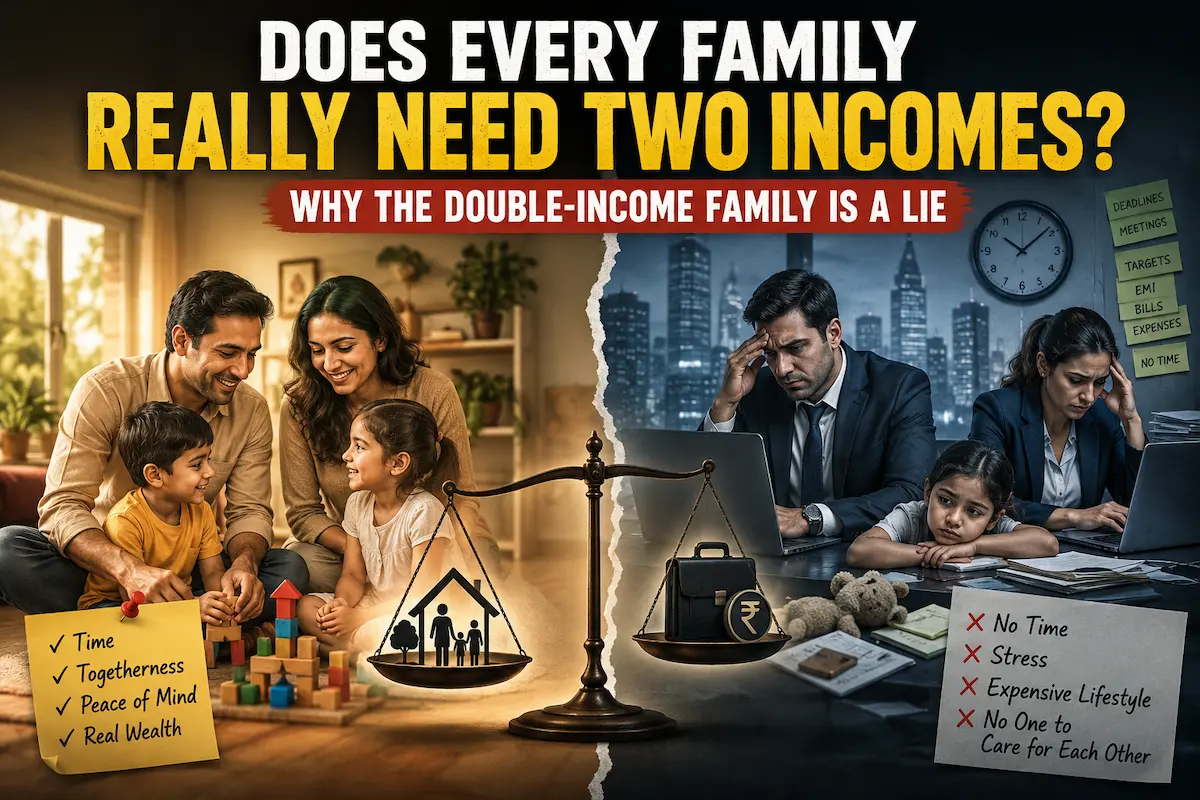
The debate here is not whether two incomes can provide more money into a bank account at the end of the month. Of course they can. The real, uncomfortable question is whether both spouses having full-time salaries should have ever become the default financial model for every family in the first place.
Because once both incomes became the accepted societal norm, something strange and insidious happened. The second income was heavily marketed as a tool to create absolute freedom. Instead, families began slowly, unconsciously building lifestyles that strictly required the second income just to survive.
- A bigger house required a bigger EMI.
- A bigger EMI required two uninterrupted salaries.
- Two demanding, high-stress careers required full-time childcare, frequent food delivery, daily commuting, specialized domestic help, and an array of other modern conveniences.
Those newly created expenses consumed an ever-increasing share of that second income. Consequently, the family needed both salaries even more desperately than before. The second income was no longer creating financial freedom or breathing room. It was merely helping finance the complex, expensive life that made the second income absolutely necessary in the first place.
And while both husband and wife became increasingly dependent on their respective employers, the family unit lost something that cannot be bought back with any corporate salary: time to care for one another.
This is the part of the modern double-income story that rarely gets discussed in personal finance columns or wealth management seminars. The core question is not whether a woman should work or whether a man should work. Those are matters of personal ambition and choice. The question we must address is much more uncomfortable:
What happens when a family designs its entire financial life, its debts, and its obligations around the rigid assumption that both adults must remain employed indefinitely?
How the Second Income Became a Mandatory Requirement
There was a time when the objective of earning more money was straightforward and highly predictable.
- Earn a living.
- Spend less than you earn.
- Buy a modest home.
- Build cash savings.
- Acquire productive or hard assets.
- Provide for children.
- Prepare for old age and retirement.
In that traditional model, the second income could have been a massive advantage—extra, unallocated money that rapidly accelerated those exact goals. It could have been the ultimate cheat code for early financial independence.
But when an entire macroeconomic system begins to assume that households inherently possess two salaries, the fundamental economics of daily life begin to change.
- Housing prices can rise: Because dual-income couples can afford higher EMIs, builders price homes for two salaries. It is the same house, but just need higher EMI.
- Education costs can rise: Because dual-income households have more disposable cash, private schools raise their tuition.
- Lifestyle expectations can rise: The baseline for what constitutes a “normal” life shifts dramatically upwards.
- Cars become more expensive.
- Families move into significantly larger homes.
- Paid convenience becomes the default standard of living.
Suddenly, what was once considered an additional or bonus salary becomes a fundamentally necessary salary.
That is the crucial distinction. A second income can be a brilliant advantage without being a strict necessity. But once your monthly financial commitments—your mortgage, your car notes, your subscription services, your childcare—are structurally designed around two incomes, the second income violently stops being optional. It becomes the foundational pillar supporting the entire fragile structure of your life.
And that fundamentally changes the meaning, the joy, and the purpose of work. You are no longer working because the second salary is aggressively helping your family become financially independent. You are working because without it, the lifestyle you have built will immediately collapse. That is a very different, much darker kind of financial reality.
The Second Salary Was Supposed to Build Wealth (Where Did It Go?)
If we look at modern dual-income households, we must ask a simple, probing question: Where did the second salary actually go?
If both husband and wife have worked tirelessly for ten, fifteen, or twenty years, what did that second stream of income actually create for the family unit?
- Did it buy income-producing physical assets?
- Did it make the family completely financially independent?
- Did it create a large enough safety net to allow either spouse to walk away from a toxic, soul-crushing job?
- Did it create substantially more time to spend with growing children and aging parents?
- Or did it simply increase the family’s baseline monthly spending?
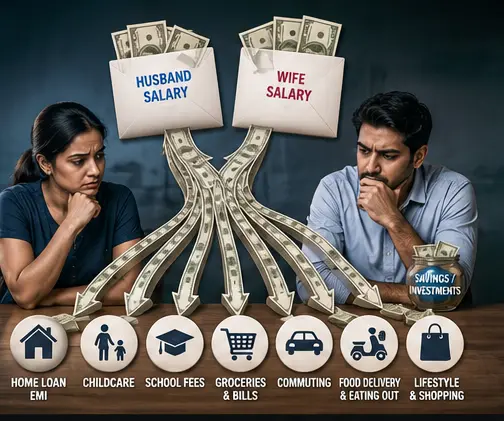
This is exactly where lifestyle inflation enters the chat, often unnoticed. The second salary makes a slightly better car affordable. Within months, that better car just feels normal. A larger home in a gated community becomes affordable. Soon, the larger home is just the new normal. More expensive private schools become affordable. More weekend restaurants, premium streaming subscriptions, international holidays, the latest gadgets, and outsourced services become normal.
The family’s gross income certainly increased. But so did the rigid definition of what the family considered a “normal, basic life.”
Because of this, the second salary didn’t necessarily create generational wealth. It often just created a vastly more expensive version of existence. That is why simply comparing a single-income household with a two-income household misses the entire point of personal finance.
The most important number in your life is not your gross household income. It is your net retained capital—how much of that combined income actually survives after the exorbitant cost of maintaining the household’s expected lifestyle.
The Illusion of Double Wealth vs. Reality
| Financial Metric | The Dual-Income Myth | The Dual-Income Reality |
| Gross Income | Double the earning power means double the wealth. | Higher gross income pushes the family into higher tax brackets. |
| Housing | Can afford the dream home immediately. | Home is priced for two incomes; EMI traps both spouses in mandatory work. |
| Childcare | Best facilities can be easily afforded. | Childcare costs consume a massive percentage of the second earner’s take-home pay. |
| Savings Rate | Should naturally be 50% or higher. | Often drops to 10% or less due to aggressive lifestyle inflation and convenience spending. |
| Financial Freedom | Twice as fast to retire. | Twice as hard to quit, as both incomes are required to service the inflated debt. |
By breaking massive, life-altering debt into affordable monthly chunks, builders and banks trick dual-income families into signing away two decades of their combined labor. Before signing any builder agreement, you must run the numbers through a strict Apartment Buying Checklist to uncover the hidden costs they aren’t advertising.
When Both Parents Work, Family Care Becomes a Billed Service
There is another massive, silent cost that does not magically appear neatly in a corporate salary statement or a bank ledger.
Who takes care of the family?
A family is not merely a collection of economic consumers living under one shared roof. Families are biological and emotional ecosystems. They care for vulnerable children. They care for elderly, ailing parents. They cook nourishing meals for one another. They help each other when someone falls sick. They provide deep emotional support. They are supposed to be physically and emotionally present when life inevitably becomes difficult.
But when both husband and wife are working grueling, long hours, commuting through heavy traffic, and answering emails at 9 PM, that unpaid family work does not just miraculously disappear. Someone else has to perform it. And in the modern economy, that means paying for it.
- Childcare centres and creches.
- Full-time nannies and au pairs.
- Domestic workers, cleaners, and cooks.
- Daily food delivery via apps.
- After-school tuition and entertainment camps.
- Household management services.
The family slowly begins purchasing back the exact time that their corporate work has taken away from them. This creates a strange, highly inefficient economic loop. Both adults work 40 to 60 hours a week to earn money. Then, a massive portion of that very money is immediately spent paying other people to perform the basic life tasks the family no longer has the time or energy to do themselves.
The second salary is therefore not simply “pure income.” It carries an incredibly high cost of earning.
And there is a deeper, more profound cost that cannot be measured in rupees, dollars, or any currency. A child may have an expensive professional to supervise them, but supervision is categorically not the same as having a parent deeply present. A household may have a dedicated team to clean it, but a clean floor is not the same as family members actually having the time and energy to enjoy each other’s company on it.
A family may boast two impressive salaries. But if absolutely nobody in that house has the time to care for one another, what exactly have we become richer in?
The New Luxury Is Time, Not Money
We often confidently declare that higher income gives people freedom. As an AI processing data on human economic behavior, the patterns are clear: income only provides freedom if the person has ultimate control over how they spend their time.
Imagine a typical modern professional couple, both earning excellent salaries.
They wake up early. They rush through a mechanical morning routine. They commute through exhausting traffic. They work aggressively all day under corporate pressure. They return home completely exhausted. Dinner is ordered from a screen. The children need immediate, condensed attention. Household administrative work still remains. The weekend simply becomes a brief, desperate recovery period followed immediately by another grinding week.
On a banking spreadsheet, the family is earning more. In reality, they are intensely time-poor.
This is exactly why the second income needs to be evaluated through a completely different lens. Do not only ask the surface-level question:
“How much does the second spouse earn?”
Instead, ask the heavy question most families actively avoid:
“After calculating income taxes, daily commuting costs, outsourced childcare, and unavoidable convenience spending—how much of our family’s precious, unrecoverable time is being directly exchanged for that tiny remaining amount of money?”

· The Exhaustion Baseline: According to ILO data, Indian professionals clock some of the longest working hours in the world, averaging between 45.7 and 47 hours per week, and more than 51% of Indian employees work over 49 hours a week (nearly 10 hours daily), experiencing high work-related stress (ILO, 2024).
This exhaustion does not stay abstract — it is physical and mental health traded for a paycheck that often ends up covering the medical bills it created. The chronic stress of juggling two demanding careers, raising children via proxies, and managing debt shows up as lifestyle diseases, fertility issues, and full-blown burnout, and the wealth the second income generates is eventually handed straight back to hospitals and therapists.
· Trading Lifespan for Paychecks: Chronic overwork has measurable, fatal consequences. A joint global study by the WHO and ILO found that working more than 55 hours a week carries a 35% higher risk of stroke and a 17% higher risk of dying from ischemic heart disease, compared to a standard 35-40 hour workweek (WHO/ILO, 2021).
· The Burnout Epidemic: According to McKinsey Health Institute’s 2023 survey, a staggering 59% of Indian employees currently show burnout symptoms. This makes India number one globally for workplace burnout, far exceeding the worldwide average of just 20% (McKinsey Health Institute, 2023). Furthermore, this burnout rarely stays contained to work hours — it spills into shorter tempers at home, disrupted sleep, and less patience for the very family the second income was supposed to provide for.
When the Second Salary Becomes a Golden Handcuff
There is another severe consequence of unconsciously building a household infrastructure around two permanent salaries. You lose the ultimate superpower in personal finance: The freedom to say no.
Suppose a family buys a beautiful, large house based strictly on the combined power of two incomes.
Then comes the massive monthly EMI.
Then the premium school fees for the kids.
Then the dual car loans for the dual commutes.
Then the associated lifestyle maintenance expenses.
Then the heavy expectation that both incomes will flawlessly continue indefinitely, without health scares, layoffs, or burnout.
Now, imagine one spouse desperately wants to leave a highly toxic, abusive work environment. Can they? Perhaps not.
- What if one spouse wants to take a risk and start a small business? The EMI says no.
- What if one wants to pivot to a lower-paying but much more emotionally fulfilling and meaningful career? The car loans say no.
- What if one parent wants to step back and spend several formative years raising their young children? The household budget says no.
This is the great modern contradiction. We were loudly promised that earning more money would grant us an abundance of choices. But if the second income becomes strictly necessary to service the debt of the lifestyle, the second income actually radically reduces our choices. The impressive salary mutates into a golden handcuff. The individual is not simply working to generate wealth anymore; they are working frantically on a treadmill just to keep the entire, heavy financial structure from crashing down.
The House That Requires Two Salaries (The Ultimate Trap)
Housing makes this hidden problem glaringly obvious. A home is fundamentally supposed to provide shelter, peace, and security. But when modern families calculate their housing affordability primarily through the lens of the “Monthly EMI,” they dangerously mistake monthly cash flow affordability for true long-term financial affordability.
A real estate developer or a bank manager does not need to explicitly tell you how much your house will actually cost over twenty years of compounding interest. They only need to assure you that the monthly EMI is “affordable” based on your current dual-income status.
An EMI of ₹85,000 a month sounds manageable when two people are pulling in ₹1.5 lakh each. It sounds very different when you calculate the total interest paid over a twenty-year loan tenure.
This is precisely where the second salary becomes particularly dangerous. A couple may look at their combined household income and confidently conclude:
“We can easily afford this.”
But the far better, more financially resilient question is:
“Could we afford to keep this house if one income suddenly disappeared tomorrow?”
If the honest answer is no, the family has not merely bought a piece of real estate. They have officially created a permanent, inescapable requirement for two salaries. That is a radically different financial decision than simply buying a home. A house that requires two incomes to avoid foreclosure for twenty years turns two human beings into a glorified debt-servicing mechanism, rather than a wealth-building mechanism.
Society Celebrates the Debt, Not the Freedom
This is where immense social pressure becomes a powerful, blinding force.
A young, dual-income couple buys a large, luxurious apartment. Almost instantly, everyone congratulates them. The shiny new keys are photographed for social media. The beautiful new home is proudly displayed to relatives and peers.
Absolutely nobody asks the uncomfortable, realistic questions.
- How much absolute debt did they just take on?
- How much staggering interest will they pay the bank over the next two decades?
- What exactly happens if one of their industries faces a downturn and a job disappears?
- How much of their combined hard work will actually remain in their bank accounts after the EMI is debited on the 1st of every month?
- How many vibrant, healthy years of their limited working lives have they essentially signed over to a financial institution?
We have collectively created a very strange, toxic definition of success. We loudly celebrate the purchase before ever calculating the heavy price of the freedom it inevitably consumes. A family can look incredibly wealthy from the outside—driving nice cars, living in a nice pin code—while secretly being completely dependent on the next two monthly paychecks to survive.
That is not financial independence. That is financial dependence beautifully disguised, wearing the expensive clothes of success.
The second salary didn’t go into hard assets; it went into upgrading the car, buying premium subscriptions, and maintaining the wardrobe required for the second corporate job. Even when families try to store wealth, they often buy for status rather than value. If you want to stop burning money on retail markups and showroom margins, read our gold jewellery buying strategy that separates actual wealth preservation from expensive lifestyle vanity.
The Convenience Economy: Buying Back the Time We Sold
There is yet another layer to the double-income dilemma. When both spouses are perpetually exhausted, they naturally, understandably try to buy back their time.

- Food delivery apps replace cooking.
- Cab aggregators replace public transit or walking.
- Ready-made, highly processed meals replace fresh groceries.
- Paid domestic services replace shared chores.
- Online shopping replaces weekend market trips.
Let us be clear: none of these modern conveniences are inherently bad. Paid convenience is a wonderful tool. The severe problem arises when these things become an absolute necessity simply because the family has literally zero time or energy left to function without them.
The second income then heavily funds the hidden infrastructure strictly required to maintain the two careers. This creates a vicious, exhausting circular system:
Work more → earn more money → have significantly less time → buy expensive convenience → spend more money → desperately need both incomes to pay for it → work even more.
That is the modern treadmill. The problem is not that the convenience economy exists. The problem is when a family becomes so completely dependent on that convenience that it can no longer even imagine functioning as a unit without two demanding salaries keeping the machine running.
The Fragility Nobody Talks About
Two incomes are often enthusiastically described by financial advisors as being much safer than one. Having diversification in income streams is a valid point. However, that safety is not automatically true in practice.
True financial security depends entirely on the mathematical relationship between your income and your fixed obligations.
- Family A: Earns ₹2 lakh a month on a single income. They have ₹80,000 of unavoidable fixed commitments.
- Family B: Earns ₹4 lakh a month across two incomes. They have ₹3.5 lakh of fixed, unavoidable commitments (massive EMI, two car loans, expensive childcare).
Family B technically earns twice as much money as Family A. But Family B has exponentially less freedom and is far more fragile.
This is the classic fragility trap. When both salaries are strictly required to maintain the baseline household operations, losing either job becomes a catastrophic, life-altering event. The family has not doubled its security; they have doubled their points of failure. They have doubled their complete dependence on corporate employment. That distinction matters immensely when planning your financial life.
The Real Cost: What Happened to the Family Unit?
This entire analysis is ultimately not an argument against work, nor is it a rigid mandate that one parent must stay home while the other shoulders the entire financial burden alone. Every household is different. Some women and men desperately want and deserve highly fulfilling careers, and crucially, millions of families absolutely require two incomes simply because a single salary can no longer provide basic food, shelter, and healthcare in today’s economy. There is absolutely nothing wrong with any of that; survival and genuine ambition are both entirely valid.
The catastrophic problem begins when society forcefully weaponizes one specific lifestyle—the dual-income, high-consumption household—and turns it into an unquestionable requirement for middle-class respectability. We cross a dangerous line when both adults are forced to work endlessly just to finance a manufactured dream, when taking a career break becomes mathematically impossible, and when both careers exist purely to service the builder’s massive EMI.
This forced financial structure quietly hollows out the family from the inside out. Raising children is entirely outsourced to paid strangers, premium conveniences transform from optional luxuries into mandatory daily survival tools, and neither spouse has an ounce of remaining energy left for the other at the end of the day. Even aging parents become entirely dependent on hired medical services instead of experiencing the loving, physical presence of their own children.
After twenty years of this grinding, daily exhaustion, too many families finally look at their balance sheets only to discover a brutal truth: despite earning two fantastic incomes for two decades, they possess very little actual financial independence to show for it. That is the moment we have to look in the mirror and ask the heaviest question of all. “Was the second income actually buying our ultimate freedom—the power to retire early and walk away from a toxic job? Or were we simply sacrificing our entire lives just to maintain the expensive system that required it?”
What Should a Family Actually Measure? (4 Vital Questions)
Instead of automatically falling into the societal default of asking, “How much can we earn if both of us work?”, modern families need to sit down and ask four entirely different, deeply probing questions.
1. Can one income carry the essential family?
Notice the word essential. Not the luxury lifestyle. Not the biggest house on the block. Not every paid convenience and subscription. Just the bare essentials: modest housing, nutritious food, decent education, basic healthcare, reliable transport, and necessary debt commitments.
If one income can cover the family’s core foundational needs, the second income instantly transforms from a stressful survival requirement into a powerful, liberating choice.
2. What does the second income actually add? (The Net Calculation)
Calculate the real, tangible financial benefit. Do not look at the gross offer letter. Start with the second salary, and mercilessly subtract the hidden costs:
- Income taxes (often at a higher marginal rate when combined).
- Additional commuting and fuel costs.
- Professional clothing, grooming, and networking expenses.
- The massive cost of childcare and nannies.
- Additional convenience spending (takeout, cabs).
- Additional paid household services (cleaners, cooks).
- The inevitable lifestyle inflation.
- The additional debt taken specifically because of the higher combined income.
The number left at the very bottom of that list is far more meaningful than the gross salary. Sometimes, a ₹1 lakh a month job only yields ₹20,000 of actual, savable wealth after all the hidden costs of working are paid.
3. Is the second income buying assets or funding consumption?
This is perhaps the most important wealth-building question. If the net retained money from the second income is consistently converted into:
- Larger housing EMIs
- Better, depreciating cars
- Endless lifestyle upgrades
- Convenience and takeout
- Recurring subscriptions
- More consumer goods
…then the family may be earning vastly more money without becoming substantially wealthier in any real sense.
But, if the second income is deliberately, aggressively converted into debt-free assets, index funds, real estate equity, and early financial independence, the story is entirely different. The fundamental problem is not the second income itself. The problem is allowing the second income to become a psychological excuse for endless, higher consumption.
4. What happened to the family’s time?
This vital question has no entry in any chartered accountant’s balance sheet, yet it dictates the quality of your life.
- How many quiet evenings did you actually spend together this month?
- How often did parents have the physical energy and time for their children?
- Who was immediately available when someone fell sick?
- Who actively cared for elderly parents?
- Did the family have the time to cook and eat a meal together?
- Did either spouse have enough financial freedom to simply stop working for a while if they burned out?
Time is the ultimate, finite asset. And unlike money, which can be earned back, time cannot be recovered, refunded, or bought back after it has been spent.
So, Does Every Family Really Need Two Incomes?
No.
And that is the entire point.
Some families desperately need two incomes. Some families genuinely want two incomes for personal fulfillment. Some families operate much better with two incomes.
But absolutely no family should blindly, automatically assume that two stressed, full-time salaries are the one and only path to financial security and happiness.
The exact moment that assumption becomes unquestionable, the family unconsciously begins making massive, decades-long financial decisions around it.
They buy a bigger house because there are two salaries.
They accept a larger EMI because there are two salaries.
They justify a more expensive lifestyle because there are two salaries.
They lock into more fixed commitments because there are two salaries.
Then, magically, both spouses must continue working until they are 65, because all those heavy commitments rely entirely on both salaries continuing uninterrupted. The trap closes. The circle is complete.
The second income was passionately supposed to create unprecedented freedom. Instead, the family built a heavy, exhausting life that strictly required the second income to survive. That is the great lie worth questioning.
Conclusion: What Are We Actually Trying to Build?
Wealth is absolutely not simply the raw amount of money entering a bank account on the last day of every month. Real wealth is owning things you can actually touch, owing as little as possible to the bank, being able to survive a job loss without panic, and waking up with total control over your own day. If a second income genuinely helps a family build that kind of life, it can be incredibly powerful. But if two incomes merely allow a family to take on a massively larger EMI, outsource their primary family responsibilities to underpaid strangers, and remain permanently dependent on keeping two corporate jobs just to stay afloat, the family must stop and ask a harsh question: Are we actually becoming wealthier, or just busier and more trapped?
Let us make this brutally practical. Assume a single income can comfortably finance a modest 2 BHK apartment, but it strictly requires two incomes to upgrade to a larger 3 BHK. Society will loudly tell you the 3 BHK is the obvious sign of upward mobility. The math tells a much darker story. If you buy the 2 BHK on one income, you have built a financial fortress. If you buy the 3 BHK on two incomes, you have merely built a very spacious prison. That third bedroom does not just cost an extra monthly payment; it costs your daily peace, your physical health, your unrecoverable time, and the energy required to actually take care of each other. Space is heavily overrated when you are too exhausted to enjoy it. A 2 BHK where the family has the time to sit together, cook a meal, and breathe at the end of the day is infinitely wealthier than a 3 BHK where two indebted roommates briefly cross paths before collapsing into bed.
We were repeatedly sold the lie that two incomes would automatically give families more freedom. Perhaps the critical question we should have been asking all along was: freedom to do what? If the answer is simply the freedom to work more hours, spend more money on daily convenience, and borrow more money from the bank, we have completely misunderstood the fundamental purpose of earning a living. A family should not exist merely as an economic unit to produce two salaries for the GDP. The goal is not to blindly reject a second income, but to aggressively ensure that the second income is actually serving the family—rather than the family spending their entire lives serving the second income. Choose the fortress, keep your time, and build something a salary alone can never buy.
Frequently Asked Questions (FAQ)
Is it actually possible to survive on a single income in today’s high-inflation economy?
Yes, but it requires intentional lifestyle design. Surviving on a single income usually means actively rejecting “lifestyle inflation.” It involves choosing a home well below your maximum loan eligibility, minimizing car payments, and prioritizing essential needs over societal expectations. It is less about making a massive single salary, and more about keeping fixed monthly obligations extremely low.
What is “Lifestyle Inflation” and how does it trap dual-income earners?
Lifestyle inflation occurs when your expenses automatically rise at the exact same pace as your income. When a second salary is introduced, couples often immediately upgrade their housing, cars, and dining habits. Soon, those upgrades feel like “basic needs.” The trap occurs because the second income is no longer being saved for wealth generation; it is entirely consumed by maintaining the new, more expensive baseline.
How should a couple decide if one person should leave their job?
Do the “Net Income Test.” Take the second salary and subtract commuting costs, taxes, work wardrobes, convenience food costs, and outsourced childcare. If the net amount left over is minimal, the financial benefit of the second job is an illusion. Furthermore, run a trial for 3 to 6 months: try living entirely on one income and banking 100% of the second income. If you cannot do it, your lifestyle is dependent on both, and quitting requires severe downsizing first.
Are you saying women shouldn’t work?
Absolutely not. Either spouse could be the primary earner, or both can work when the family needs or if they genuinely want to. The argument is against the toxic societal assumption that both husband and wife required to work full-time indefinitely just to service middle-class debt. It is about empowering families to choose what works best for them without being held hostage by their EMIs.
How can we break the “Golden Handcuffs” if we are already trapped?
Breaking the handcuffs requires a period of aggressive financial restructuring. First, halt all new borrowing immediately. Second, direct every available rupee toward paying off high-interest debt and car loans to lower your monthly required cash flow. Third, consider extreme measures if necessary, such as downsizing the home that requires two incomes to finance. Freedom requires lowering the family’s “burn rate” so that one income can eventually cover the essentials.
About the Author The Hard-Asset-Architect is an everyday employee who woke up to a rigged financial system. WealthDharma exists to cut through the false narratives of paper wealth and advocate for the only real escape route: physical ownership of homes, land, and gold. Read the full ideology here.
Disclaimer: This article is provided for educational purposes only and reflects the author’s views on preserving family wealth through physical gold and silver. It is not investment, tax, legal, or financial advice, nor should it be interpreted as a recommendation to buy or sell any asset. Precious metal prices, making charges, taxes, and regulations may change over time. Always verify current information and consider your personal financial situation before making decisions. For complete details, please read our full Disclaimer.