Buying gold jewellery in India is never just a purchase. It connects family continuity, cultural identity, and long-term financial security in a single transaction. Yet most people approach it without a framework — buying when occasions demand, guided by design preferences or volatility in gold prices rather than deliberate strategy. The result is random accumulation, hidden losses from making charges, and jewellery that breaks under real use instead of building lasting wealth.
A smart gold jewellery buying strategy in India treats every purchase as part of a lifetime system — not a one-time transaction whenever money is available. Before you buy a single gram, you need a clear architecture: why you are buying, how much, and for whom. This guide is that system.
Table of Contents
Phase 1 — Audit Your Existing Gold Jewellery Before Buying More
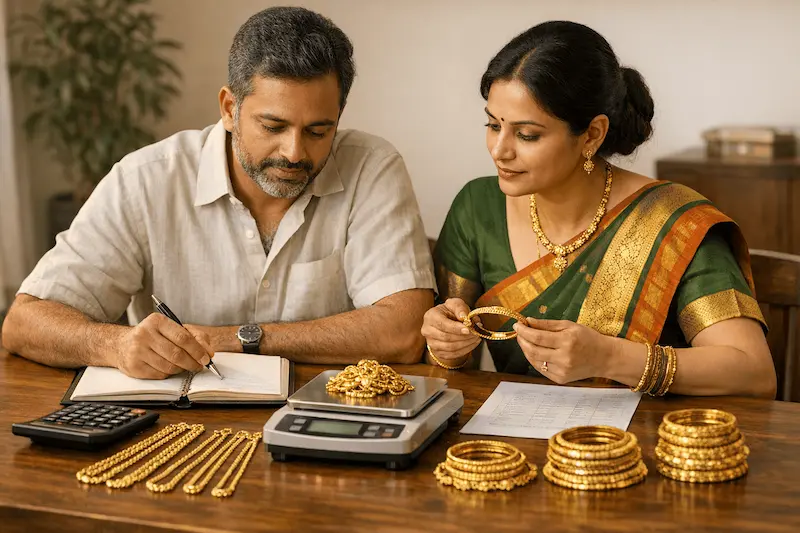
Most Indian families have accumulated gold over decades — from weddings, festivals, gifts, and inheritance. But very few have a clear picture of what they actually own. Without that clarity, every new purchase is guesswork layered on top of guesswork. A strong gold jewellery buying strategy in India always starts with a full audit of what already exists — not with a trip to the showroom.
Step 1 — Identify what you own
List all jewellery across every family member. Include inherited pieces and items that have not been worn in years. Note the weight, type, and approximate frequency of use for each item. Most families are surprised by the total weight they already hold once they sit down and take proper stock.
Step 2 — Clarify ownership
Identify who owns each piece. Are there emotional or traditional claims attached? Some pieces carry unspoken family significance — a grandmother’s chain, a ring given at a specific occasion with specific intent.
Decide clearly: who will wear each piece, who will receive it, and when it will be passed on. This matters more than most buyers realise. Gold jewellery never becomes outdated. A daughter can happily wear the same necklace her mother wore for twenty years. A grandmother can gift her ring to her granddaughter. There is no obligation to buy new gold at every occasion — existing pieces, when properly tracked and assigned, can serve the same purpose with far greater meaning.
Step 3 — Assess utility
Separate what is worn regularly from what has been sitting untouched. Ask honestly — when was this last worn? Would it be worn again? Idle jewellery is idle capital. Understanding that gap between what you own and what you actually use is the foundation of every smart decision that follows.
👉 Read our Deep Dive: Is Gold Jewellery a Good Investment? You’re Asking the Wrong Question
Phase 2 — Decide What to Buy: The Core of Any Gold Jewellery Buying Strategy in India
The most common mistake in jewellery buying is acquiring pieces without a defined role. Every purchase should answer a single question before money changes hands: what is this piece for?
Daily wear gold jewellery
Principle: function over design
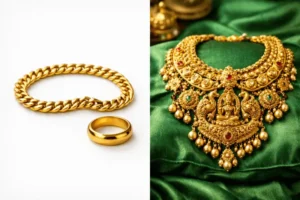
Chains, rings, and lightweight bangles meant for everyday use must prioritise durability and comfort above everything else. These pieces face real friction — daily movement, moisture, contact with other surfaces. Intricate designs wear poorly in this context, demand more maintenance, and carry higher making charges that offer no practical return. Keep daily wear simple, solid, and timeless. A plain, well-made chain will outlast and outperform an elaborate piece worn daily, every time.
Marriage gold jewellery
Principle: legacy over efficiency
Marriage jewellery is the largest single purchase most families make — and the most emotionally significant. High making charges are unavoidable, and these pieces are not meant to generate financial returns. They represent family continuity, the visible mark of a life event that spans generations.
The real mistake here is not the high making charge — it is choosing a fragile, trend-driven design that requires constant maintenance rather than one built to survive decades. These pieces are worn on a single day but must last for generations.
The acquisition process for marriage jewellery is entirely different from daily wear. Decisions should be deliberate and unhurried, guided by longevity rather than current fashion. Whether you build this through 1-gram or 2-gram coins purchased gradually, through a trusted family artisan, or through gold schemes designed to offset future making charges — the strategy is yours to choose. But the principle is fixed: build for permanence.
Occasion jewellery
Principle: presence without excess
Occasion jewellery is used for functions, festivals, and formal family gatherings. Choose pieces substantial enough to carry visual presence without being so elaborate that they go unworn between events. The goal is jewellery that earns its place through repeated real use — not pieces so ornate or delicate that they require special handling every time they leave the locker.
Gold Gifting (Intent Rooted in Use and Relationships)
Principle: Meaning expressed through usefulness
In India, gifting has always been practical and relationship-driven. Unlike manufactured gifting occasions, Indian traditions anchor gold gifts to real life moments — marriages, milestones, and family functions. A well-chosen piece is not simply received; it becomes part of the recipient’s daily life, worn across years and often passed forward to the next generation.
The strength of Indian gifting lies in thoughtful selection, not social pressure. The goal is not to give random gifts, but to give appropriately. A meaningful piece—suited to the person’s lifestyle and future use—holds far greater value than a larger purchase made only to match expectations.
In gold gifting, value is not measured by weight alone, but by how naturally the piece becomes part of someone’s life.
Phase 3 — Buy Once. Buy Right. Buy for Life.
At WealthDharma, we do not encourage exchanges. We do not encourage upgrades. We do not encourage reshaping old pieces into new ones.
Whatever you buy, you buy with the intention of keeping it — for decades, and ideally across generations.
This single principle changes how you approach every purchase. Instead of asking “does this look good today?” you ask “will this still be worn thirty years from now?” Instead of choosing based on trend or occasion pressure, you choose based on durability, purpose, and longevity. The question is not whether you like it in the showroom — the question is whether it will still belong in your family long after the showroom has forgotten you.
Every piece you buy should be the last time you buy that piece.
This is why the decision must be slow and deliberate. You are not buying jewellery. You are building a collection that will outlast you. Start with smaller pieces. Use them in daily life. Understand how each piece wears, how it holds, how it fits into real use before adding more. Build gradually — but build with permanence in mind every step of the way.
The gradual build approach works only when each piece is chosen to last. Small and right is far better than large and compromised.
👉 Read Our Philosophy: Why I Still Buy Gold the Old-Fashioned Way — Not on a Mobile Screen
Phase 4 — Making Charges: Pay Once, Pay Wisely
Making charges are the fee for design and craftsmanship. They typically range from 5% to 25% or more, depending on the complexity of the design. They are not recovered at resale. When you sell or exchange, buyers pay only for the weight of the gold — the craftsmanship you paid for simply disappears from your calculation.
This is precisely why exchanges are so damaging. Each time a piece is exchanged, you absorb making charges twice — once on the original purchase, and once on the replacement. Done repeatedly, it is one of the fastest and least visible ways to shrink your total gold holdings over time.
Thinking of joining a gold jewellery scheme? First, understand the different types of gold jewellery schemes and which one may actually be worth considering.
The WealthDharma position on making charges
Because we buy for the long term, making charges become a one-time cost — not a recurring one. Paid once on a well-chosen, durable, timeless piece, they are entirely acceptable. The design cost is spread across decades of use and then across generations. If we pay again and again through unnecessary exchanges and upgrades, they become a serious and compounding financial drain.
How to reduce your making charge exposure:
- Keep daily wear designs simple.
- Reserve elaborate designs for jewellery with a clearly defined legacy purpose.
- Always ask about the buyback policy and compare making charge percentages.
- Use seasonal opportunities like Akshaya Tritiya wisely : Gold acquisition is a lifetime process — not a single purchase — aligning some purchases with these windows is a legitimate part of a smart strategy.
👉 The Silent Leak: Understanding Gold Making Charges and Your 23% Breakeven Reality
Phase 5 — The Durability Test: A Non-Negotiable Part of Your Gold Jewellery Buying Strategy in India
One of the most important — and most ignored — principles of any gold jewellery buying strategy in India is durability. Most modern showroom pieces are designed to be sold, not worn. They are optimised for display, photography, and visual impact under controlled showroom lighting, not for the friction and wear of daily life.
With advances in manufacturing, jewellers can now produce intricate necklaces in 15 grams using machinery — pieces that would have required 35 grams using traditional handcraft methods. These lightweight designs look spectacular in the showroom. In the mirror, they look extraordinary. But wear them two or three times and the reality shows: stones loosen, joints weaken, locks break. The piece must be stored in its own special box, kept in a fixed position, handled like something fragile.
We used to keep all our jewellery together in one box. Now each lightweight piece demands its own container and its own care instructions. If you wear it, it breaks. If you exchange it, you lose money. This is not wealth — it is a beautifully packaged liability.
The question to ask of every piece before buying: can this survive real life — not a showroom, not a single occasion, but real life?
The physical strength test
Hold the piece in your hand. Feel the weight of the metal. Check joints and clasps under pressure. Gently flex it. Durable jewellery feels solid and stable throughout. If it feels delicate or hollow under handling, it will not last — and it is not wealth, it is decoration.
If the salesman objects to you handling the piece this way — that is your answer. Simply do not buy it. A piece that cannot be tested in the showroom will not survive real life.
The pouch test
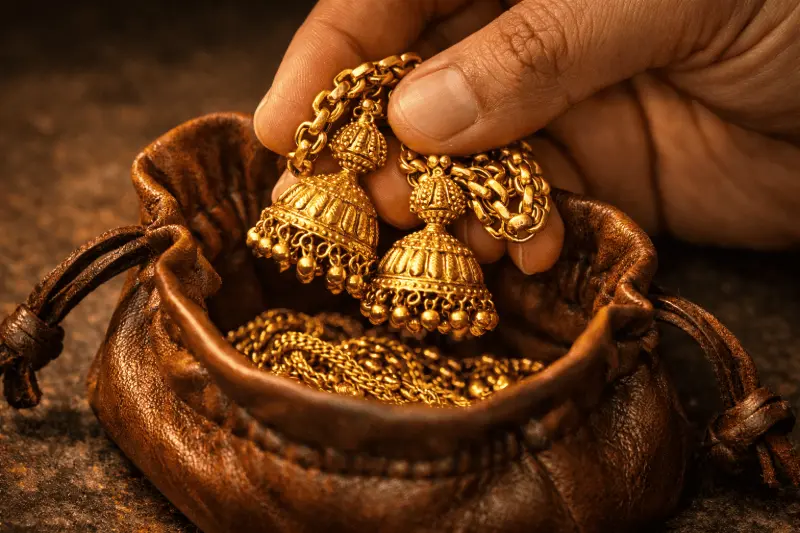
Ask yourself: can this piece be stored in a single pouch alongside other jewellery without needing special protection? If not, it is too delicate for real use. Jewellery that cannot survive basic storage will not survive generations. This is old wisdom, but it remains one of the most reliable filters available to any buyer.
Buy jewellery that can be worn, lived with, and passed on. If it requires more care than it gives, reconsider.
Phase 6 — Mistakes to Avoid When Buying Gold Jewellery
Even with a clear strategy, buying gold jewellery in India is filled with pressure points — from family expectations to festival deadlines to a persuasive salesman. These are the six mistakes that quietly drain wealth from Indian households year after year.
1. Buying without a plan:
Walking into a jewellery shop without a defined purpose is the most common and most costly mistake. Without a plan, you are making decisions based on what catches your eye in the moment — which is exactly what the showroom is designed to encourage. You end up with pieces that overlap in purpose, jewellery that duplicates what you already own, and gaps in what you actually need. Over time, this creates a collection that is heavy in weight but weak in utility. Every piece you buy should have a role before you buy it — not after.
2. Focusing only on the gold price:
Tracking gold rates, waiting for a dip, timing your purchase to the market — none of this is wrong. But it is incomplete. Gold acquisition is a lifetime process, not a single purchase. The gold price is only one variable. Making charges — ranging from 5% to 25% or more depending on design — are added on top and never recovered at resale. A buyer who saves ₹500 per gram through perfect market timing, but pays 20% making charges on an elaborate design, has still made a poor financial decision. Evaluate the total cost of ownership, not just the rate on the day.
3. Urgency buying:
Weddings, festivals, and family functions create a specific kind of pressure that is almost impossible to resist. There is a date on the calendar, a social expectation to meet, and a feeling that delaying is not an option. Jewellers understand this dynamic well — and showroom visits during wedding seasons.
Decisions made under time pressure will create enormous stress on your pocket because we have no control on gold prices and availability of designs. For Ex : Gold prices shot up from 6000 per gram to almost 16000 per gram in a span of two years. Additionally when urgently you visit the jewellery shop there may not be any offers on making charges and you have to pay full price on them. Hence cannot buy from shop hastily, you have to acquire them when ever you have money, because gold will not become old. If you find yourself buying because you feel you have to, that is the moment to slow down — not speed up.
4. Social validation purchases:
A significant portion of gold jewellery bought in India is bought not for the buyer, but for the audience. To match what a neighbour gave at a wedding. To meet a perceived standard at a family function. To avoid being judged for giving something too small. This kind of buying is driven entirely by external opinion and has nothing to do with your financial strategy, your genuine needs, or the longevity of the piece. Gold bought to impress others tends to be over-designed, overpriced, and quickly forgotten — by the giver and the recipient alike. The WealthDharma principle is simple: buy for purpose, not for perception.
5. Impractical designs:
Jewellery that must be stored in its own special box, kept in a fixed position, and handled with the care of something fragile is not an asset — it is a liability dressed in gold. Modern manufacturing has made it possible to create intricate, visually stunning pieces at very low gold weights. These designs look extraordinary in the showroom. But fragility is built into them. Wear them a few times and the damage begins. You cannot store them casually, you cannot wear them freely, and when you try to exchange them, you lose money. True wealth in jewellery is wearable. A piece that cannot be lived in cannot build a legacy.
6. Frequent exchanges:
Exchanging old jewellery for new pieces feels like a harmless refresh. It is one of the most financially damaging habits in gold ownership. When you exchange, the jeweller values your old piece on gold weight alone — making charges, stone costs, and any premium you paid for the original design are gone. You then pay making charges, stone charges, and taxes again on the new piece. This is precisely the cycle the jewellery industry depends on: keep customers exchanging every few years for the latest lightweight design, collecting charges at every turn.
At WealthDharma, we do not encourage exchanges. Whatever you buy, you buy to keep. The piece should last your lifetime and beyond. Remember jewellery is not a fashion statement, it is a cultural legacy of your family.
Quick Checklist Before Buying Gold Jewellery
Every purchase should clear all six points before you proceed:
- ✅ I know my current gold inventory — weight, ownership, and utility
- ✅ I have defined the purpose of this specific purchase
- ✅ I have checked and compared making charges
- ✅ I have verified 916 BIS hallmark purity
- ✅ I have asked about the jeweller’s buyback and exchange policy
- ✅ I have physically tested the piece for durability
Buying gold jewellery is not a transaction. It is a lifetime system. The right gold jewellery buying strategy in India is not designed for a single showroom visit — the collection is built over decades, with purpose and patience. Buy once. Buy right. Buy for life.
Frequently Asked Questions
Why should I audit my existing gold before buying more?
Most families own gold they haven’t worn in years or that may need simple repair. Auditing helps you clarify what you own, who wears it, and whether it is actually being used. This prevents you from buying redundant pieces and allows you to put ‘idle capital’ to better use.
What is the most common mistake when buying gold jewellery?
The biggest mistake is buying without a defined purpose. When you walk into a showroom without a plan, you often choose designs based on trends or showroom lighting rather than durability and longevity.
Are making charges a total loss?
In the WealthDharma framework, making charges are a one-time cost for craftsmanship. They only become a serious financial drain if you frequently exchange your jewellery. If you buy a durable, timeless piece and keep it for decades, that initial cost is spread across generations.
How can I test if a piece of jewellery is durable?
You can use the Physical Strength Test (holding the piece to feel its weight and checking joints under gentle pressure) and the Pouch Test (asking if it can be stored in a single pouch with other items without special protection). If it feels hollow or delicate, it is a decoration, not a lasting asset. Note that shopkeepers often object to these tests; if they do, that is your cue—a piece that cannot be handled in the showroom will not survive real life .
Why does WealthDharma discourage exchanging old jewellery?
Exchanging is financially damaging because jewellers usually value your old gold only by weight, meaning you lose the making charges and taxes you originally paid. You then pay those charges all over again on the new piece, which quietly shrinks your total gold holdings over time.
Is it better to buy heavy marriage jewellery or lightweight designs?
For marriage jewellery, the principle is legacy over efficiency. While modern manufacturing can create intricate designs at low weights, these pieces are often fragile and break easily. It is better to buy a solid, well-made piece that can survive decades of real-world use.
About the Author The Hard-Asset-Architect is an everyday employee who woke up to a rigged financial system. WealthDharma exists to cut through the false narratives of paper wealth and advocate for the only real escape route: physical ownership of homes, land, and gold. Read the full ideology here.
Disclaimer: This article is provided for educational purposes only and reflects the author’s views on preserving family wealth through physical gold and silver. It is not investment, tax, legal, or financial advice, nor should it be interpreted as a recommendation to buy or sell any asset. Precious metal prices, making charges, taxes, and regulations may change over time. Always verify current information and consider your personal financial situation before making decisions. For complete details, please read our full Disclaimer.