You’ve finalized the wedding, printed the photos, and found a beautiful, cozy 1BHK near the office. The rent is a completely manageable ₹15,000 a month. You look at your combined incomes and figure you can handle that in your sleep.
Then the reality of the Indian rental market hits your honeymoon phase like a brick. Many newly married couples underestimate the hidden costs of renting an apartment in India. The monthly rent may look affordable, but deposits, brokerage, furniture, appliances, and setup costs can quickly exceed your savings.
The landlord demands a 4-month deposit. The broker wants his cut. You realize you can’t live like bachelors anymore—you need a real refrigerator, a proper double bed, a washing machine, and a fully functioning kitchen.
Before you even pick out your first set of curtains, your simple ₹15,000 apartment demands nearly ₹1.5 Lakhs to ₹2 Lakhs in upfront capital.
Money is one of the leading causes of friction in the first year of marriage. At WealthDharma.in, we believe in full financial transparency and protecting your capital. Here is the unfiltered breakdown of every hidden expense you must budget for when setting up your first apartment as a couple—plus the new government rent rules that give you more legal protection than ever before.
Quick Summary: The Realistic Cost of Moving In Together
| Expense Type | The Newlywed Reality | Estimated Cost |
| Security Deposit | 2 to 4 Months Rent (depending on state laws) | ₹30,000 – ₹60,000 |
| Brokerage Fee | 1 Month Rent | ₹15,000 |
| Advance Rent | First Month Upfront | ₹15,000 |
| Society Move-In Charges | Non-refundable lift/shifting fee | ₹2,000 – ₹5,000 |
| Furniture & Appliances | Queen bed, Fridge, Washing Machine, RO | ₹75,000 – ₹1,10,000 |
| Complete Kitchen Setup | Utensils, Mixie, Stove, First Groceries | ₹15,000 – ₹25,000 |
| Moving & Logistics | Merging two households (local shift) | ₹5,000 – ₹10,000 |
| Total Reality Check | What you actually need in cash | ₹1,57,000 – ₹2,40,000 |
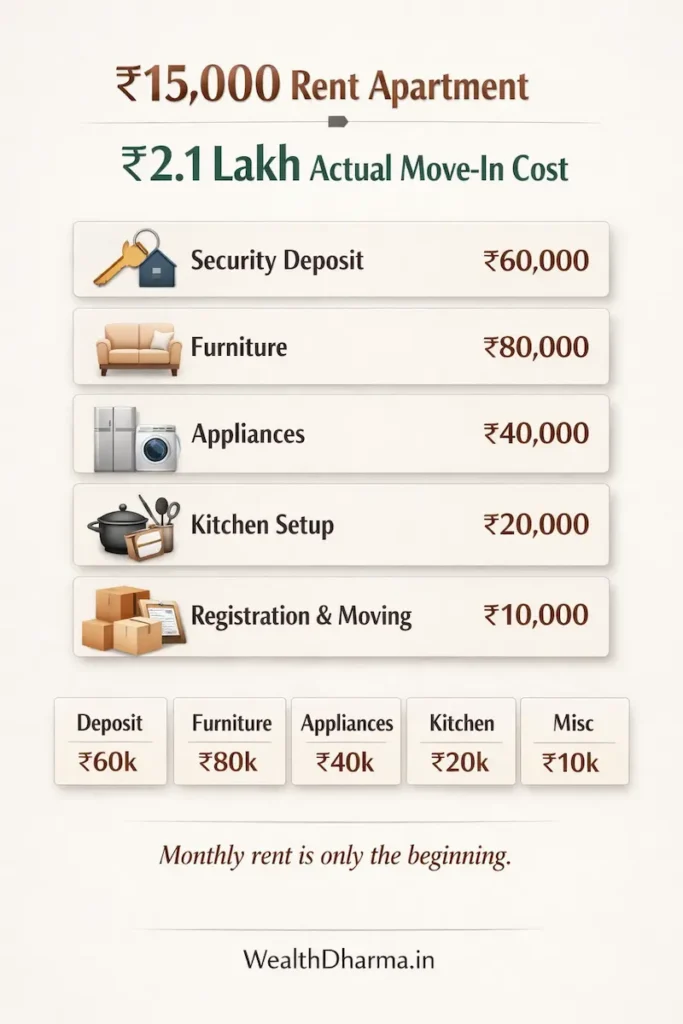
Most first-time renters focus only on monthly rent. In reality, the hidden costs of renting an apartment in India often require 8–12 times the monthly rent in upfront cash before move-in.
The Biggest Hidden Costs of Renting an Apartment in India
1. The Security Deposit Trap (And The New Legal Cap)
When you were single, you might have shared a massive deposit with roommates. As a couple, you bear the whole burden. Historically, in cities like Bengaluru and Chennai, landlords demanded an extortionate 8 to 10 months’ rent upfront.
🆕 The New Rent Rules 2025 Law: Under the nationwide rollout of the Model Tenancy Act, residential security deposits are now strictly capped at a maximum of 2 months’ rent. The Catch: While states like Karnataka and Maharashtra strictly enforce this via digital lease tracking, some unorganized landlords still push for 4 to 6 months to ensure “couple stability.”
WealthDharma Tip: Use the 2-month legal cap as your primary negotiation leverage. If you must pay more, ensure every single rupee is documented in a registered agreement.
2. The Brokerage “Tax”
In most cities, you pay the broker a fee even though the landlord hired them. The standard rate is one full month’s rent.
- The Hidden Trap: Watch out for sneaky clauses in broker receipts that demand a half-month renewal fee every year you renew your lease. Cross this out with a pen before signing.
3. The Society “Shifting Fee”
Couples tend to rent in safer, gated communities. What nobody tells you is that premium housing societies frequently charge a non-refundable Move-In / Shifting Fee ranging from ₹2,000 to ₹5,000 simply to allow your packers and movers to use the service lift.
4. Mandatory Digital Registration Costs
The era of ₹100 paper-stamp agreements typed out at a local court is officially dead. Under current laws, all rent agreements must be digitally stamped and registered online with the local Rent Authority within 60 days. Expect to pay ₹1,000 to ₹2,500 for e-stamping and digital registration processing.
If you wanted know why a Home is the Ultimate Reality of Wealth and Every one must own a Home read our article.
The “Semi-Furnished” Illusion: Your Capital Expenditure
When you are single, “semi-furnished” is enough. You can throw a single mattress on the floor. After marriage, expectations change. In India, a “semi-furnished” flat usually just gives you bare walls, ceiling fans, and kitchen cabinets.
Here is the realistic capital expenditure required to make it a functional home:
- The Master Bedroom: A reliable queen-size bed frame with a good orthopedic mattress is non-negotiable for couples. (₹16,000 – ₹25,000)
- Whitegoods Appliances : You need a 240L double-door refrigerator for proper meal prep, and a fully automatic top-load washing machine to save time. (₹31,000 – ₹42,000 combined)
- Health & Utilities: A branded RO+UV water purifier and a 2/3-burner gas stove setup. (₹13,000 – ₹18,000)
- The “Last Mile” Essentials: Curtains for three rooms, curtain rods, doormats, dustbins, bathroom fittings, a Wi-Fi router deposit, and basic cleaning supplies easily vacuum up an additional (₹8,000) in your first weekend.
Monthly Silent Killers: Budgeting Beyond the Rent
When planning your post-wedding monthly budget, your ₹15,000 rent is only the baseline. Do not forget these recurring operational costs for a two-person household:
- The Hidden Maintenance Fee: Landlords often quote a lower rent but leave out the society maintenance. For a decent apartment in a gated community, expect ₹1,500 to ₹3,500 monthly on top of your rent.
- Commercial Power Backup Tariffs: Electricity drawn from common Diesel Generators (DG) during power cuts is charged at a significantly higher commercial tariff than the standard government grid.
- Domestic Help: If you both work, hiring a maid for sweeping, mopping, and utensils will cost between ₹2,000 to ₹4,000 depending on your city.
The Ultimate Exit Blindside: The Painting Deduction
The final hidden expense happens a year or two later when you try to leave. Almost every standard rental agreement in India contains a predatory clause stating that one month’s rent will be deducted for “deep cleaning and repainting” when you vacate, regardless of how impeccably you maintained the home.
How to Protect Your Capital: On the exact day you get the keys, before you move a single box in, take a continuous, high-definition video walkthrough of the entire flat. Zoom in on existing wall stains, cracked tiles, and chipped woodwork. Send this video to your landlord on WhatsApp immediately. This is your immutable proof against false damage claims.
Tactical Advice: The WealthDharma Setup Strategy
When setting up your home, do not let the excitement of marriage trick you into buying depreciating junk. Keep it practical, protect your capital, and follow these three rules:
- Metal over plastic: Reject the use-and-throw culture, especially in your kitchen. Do not shy away from using brass, cast iron, and thick stainless steel. Yes, a heavy brass masala dabba or a cast-iron skillet costs more upfront than a stack of plastic containers which look shiny, but they do not break, stain, or poison your food. Stop chasing shiny, fragile aesthetics; buy what actually survives.
- Buy furniture slowly, but buy it for life: As young professionals, transfers and relocations happen. You do not need to fill the house with heavy furniture on day one. Build your home piece by piece as you actually need it. But whatever you do buy, make sure it is long-lasting. Avoid the cheap, engineered-wood (MDF) garbage that looks great in a showroom but crumbles the first time you load it onto a packers-and-movers truck.
- Execute it yourself (DIY): Do not pay the “convenience premium” to startups. Roll up your sleeves. Buy yourself a good tool kit box on day one— handling basic fixes like tightening a loose hinge or hanging a picture frame yourself builds self-reliance. Hire your electrician or plumber locally to reject corporates and to build neighbourhood connections.
Final Thoughts: Budget for Reality, Not for Hope
Setting up your first home as a married couple should be a source of pride, not financial panic.
The WealthDharma 6 – Month Buffer Rule : Our core advice is to implement the 6 – Month Buffer Rule. Whatever your monthly rent is, multiply it by four. Keep that exact amount as purely liquid cash in a separate savings account before you sign the lease. This covers your deposit, brokerage, society fees, and the inevitable first-month friction costs.
Don’t let hidden expenses sour your new beginning. Budget for reality, buy for permanence, and start your life together on your own terms.
Frequently Asked Questions
How much money should I save before renting my first apartment in India?
Save at least 6-8 months’ rent as liquid cash before apartment hunting. This covers the deposit, broker fee, advance rent, and basic setup costs. In Bengaluru or Chennai where old deposit norms may still apply in practice, save 8–10 months’ rent as a buffer.
Is it better to take a furnished or unfurnished flat?
A semi-furnished flat (fans, lights, wardrobe, sometimes a kitchen hob) strikes the best balance for most first-timers. Fully furnished flats cost 25–40% more in rent but save ₹40,000–₹80,000 in furniture costs upfront. Do the math based on how long you plan to stay: if less than 12 months, fully furnished often wins financially.
What are the hidden costs of renting an apartment in India?
The hidden costs include security deposits, brokerage, maintenance charges, furniture, appliances, moving expenses, registration charges, and painting deductions during move-out.
What if the landlord doesn’t return my security deposit?
Under the new rules, deposits must be returned within 30–60 days of vacating. Deductions are only valid for actual damage — not normal wear and tear. File a complaint with the Rent Authority or Rent Tribunal. The new process targets resolution in 60 days. Your move-in video and registered agreement are your key evidence.
Does rent include maintenance charges?
Not always. Many listings quote rent “exclusive of maintenance.” Always clarify before signing. Maintenance of ₹1,000–₹5,000/month significantly changes your real monthly cost.
Is an 11-month rent agreement still valid under the new rules?
The 11-month format still exists, but under the New Rent Rules 2025, all agreements must now be digitally registered within 60 days regardless of tenure. Without registration, the agreement may not be enforceable in Rent Tribunals, and you risk a ₹5,000+ penalty.
About the Author The Hard-Asset-Architect is an everyday employee who woke up to a rigged financial system. WealthDharma exists to cut through the false narratives of paper wealth and advocate for the only real escape route: physical ownership of homes, land, and gold. Read the full ideology here.
Disclaimer: This article is intended for educational and informational purposes only. It reflects general financial principles and the author’s views on home ownership. It should not be considered legal, tax, financial, or real estate advice. Every family’s financial situation is different. Please evaluate your own circumstances and consult a qualified professional before making significant financial decisions. For additional information, please read our full Disclaimer.