Core Truth: Modern finance treats gold jewellery as a “bad investment” due to high making charges and leakage. They are mathematically correct, but philosophically wrong. Gold jewellery isn’t a tool for returns—it is a vessel for legacy, identity, and unshakeable physical wealth that survives when systems fail.
Is gold jewellery a good investment in India? It sounds like a practical question. But it is the wrong question.
Most people ask this while standing in a brightly lit showroom, mesmerized by design and discounts. But the real issue isn’t the price of gold. The real issue is that you’ve been trained to view everything in life through the lens of “return on investment.”
Some things are not meant to give returns. They are meant to preserve something deeper.
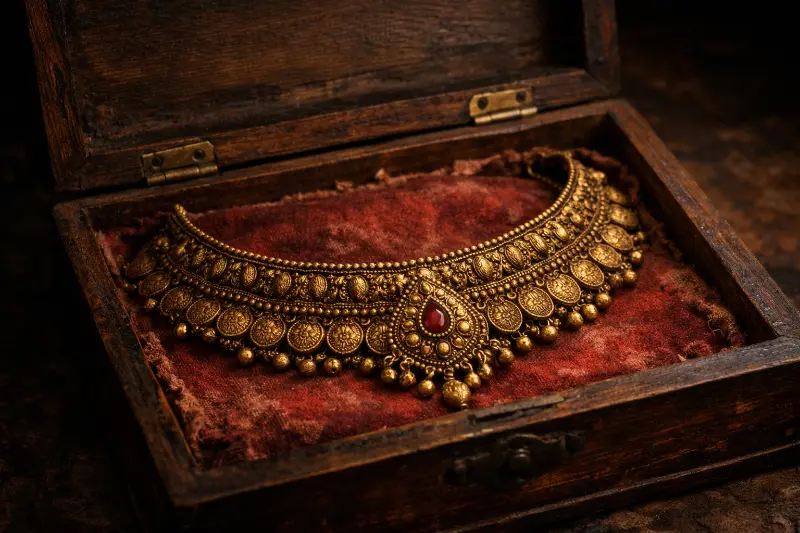
that no financial tracker or digital ETF can measure.
The Inefficiency Trap: Why Gold Jewellery Fails as an Investment
If you look at gold jewellery as an investment, you’ve already made a mistake. It is mathematically inefficient from day one. When you buy a gold chain or necklace, you are not just buying gold. You are paying for:
- Making Charges: Locking away 8% to 25% of your capital in craftsmanship.
- GST: A flat 3% cost that is never recovered.
- Retail Overheads: Paying for branding, showroom costs, and margins.
An investment is supposed to preserve value with minimal friction. Jewellery does the opposite—it starts with a built-in loss the moment you walk out of the store.
Gold Jewellery vs. Gold ETF: What Are You Really Buying?
Before going further, understand this clearly: You are not choosing between “better gold.” You are choosing between different purposes.
A gold ETF sits quietly in a demat account as a digital asset. Jewellery, on the other hand, carries memory, identity, and continuity. If you want efficiency, buy an ETF or a gold bar. But don’t confuse financial instruments with cultural assets.
The Distinction: A gold ETF is a financial instrument; a gold coin is efficient storage of value; and gold jewellery is legacy.
Investment Is a Path. Wealth Is the Destination.
Modern finance has conditioned people to think like spreadsheet managers—tracking returns, percentages, and short-term gains. The real mistake is deeper than making charges. You are judging the wrong thing with the wrong lens Investment is just a path. Wealth is the destination. Wealth is not just numbers on a screen. It is:
- Security that doesn’t depend on a password.
- Ownership you can physically hold.
- Value that will survive not market cycles but for generations.
Gold jewellery does not belong in your portfolio—it does not ‘represent’ wealth. It is wealth.
The Ledger vs. The Bloodline
A gold ETF lives in your financial ledger. Gold jewellery lives in your family.
Jewellery marks life events—a wedding, a birth, a milestone. In Indian households, this has always been understood as Stree-Dhan—a form of financial security that is personal, portable, and independent. One belongs to the system; the other belongs to the bloodline.
The Power of Physical Ownership
We are moving toward a world where most assets are digital. Your bank balance is a number; your “digital gold” is a claim backed by a system. But what happens when access is restricted?
Gold jewellery requires:
- No password
- No platform
- No intermediary
This independence is its real value. You are paying for control.
If you want to understand exactly why I refuse to trade this independence for the convenience of an app, read my full breakdown on why I still buy gold the old-fashioned way—not on a mobile screen.
The Pulse of Wearable Wealth
Yes, you can hold a gold coin in your hand. But a gold coin sits in a dark locker, cold and forgotten until you need to sell it. It is nothing more than efficient storage.
Jewellery operates in a completely different dimension. It carries a pulse.
When you buy a gold bangle or a necklace, it doesn’t go into a vault—it is worn by someone you love. It absorbs memories. It is present at weddings, births, and milestones. You are not just paying a “making charge” to a jeweler; you are paying to turn cold metal into a living piece of your family’s history.
Modern finance tells you this is a poor investment because the premium you pay vanishes. But a spreadsheet cannot measure the security and weight of an asset that lives and breathes with your bloodline. A gold coin is an asset you own. Gold jewellery is an asset you experience.
👉 To understand how to buy jewellery that lasts generations, follow our Gold Jewellery Buying Strategy in India.
Gold Coins vs. Jewellery vs. ETF: Choosing the Right Purpose
| Feature | Gold Coins / Bars | Gold Jewellery | Gold ETF |
| Purity | 24K (99.9%) | 22K / 18K | 99.5%+ (Backed) |
| Making Charges | Low (1% – 4%) | High (8% – 25%+) | None |
| Primary Goal | Savings / Liquidity | Usage / Legacy | Investment / Returns |
| Storage | Home / Locker | Worn / Home | Digital (Demat) |
| Resale Value | High (Weight based) | Lower (Labour lost) | Full Market-linked |
Gold ETF (The Investment Path)
Efficient, liquid, and ideal for tracking gold prices. There are no making charges, no storage risks, and it offers high liquidity.
However, gold prices do not rise consistently over time. Prices can remain flat or even decline for years. Many investors who bought at peak cycles have seen gold stay below their purchase price for 3 to 5 years (For ex : from 2012 to 2020 gold gave negative returns), resulting in poor returns or even losses during that period.
It remains a financial asset—efficient, but dependent on market timing and price cycles.
Gold Coins (Efficiency)
Gold coins and bars are built for one purpose: efficient storage of value. They typically come in 24K purity (99.9%), which ensures you are buying almost pure gold with minimal compromise. Unlike jewellery, the making charges are low—usually between 1% to 4%—which means most of your money actually goes into the metal itself.
When it comes to resale, coins perform far better than jewellery. You are paid primarily for the gold weight, not penalized heavily for lost craftsmanship. This makes them a practical option for those who want physical ownership without unnecessary cost leakage.
However, coins are still passive assets. They do not generate income, and their value depends entirely on gold price movement. They are not tools for growth—they are tools for preservation. They also serve a secondary cultural role in India—small denomination coins (1g, 2g, 5g) are widely used for gifting during festivals and family occasions. In this sense, they sit between pure efficiency and social utility.
Gold Jewellery (Wealth & Utility)
Gold jewellery operates in a completely different dimension. It is not designed for efficiency—it is designed for utility, identity, and continuity.
Unlike coins, jewellery is rarely 24K because pure gold is too soft for practical use. It is usually crafted in 22K or 18K, sacrificing some purity for durability and design. Along with this, you pay significant making charges, often ranging from 8% to 25% or more. This cost is largely unrecoverable when you sell.
From a purely financial perspective, this makes jewellery a weak investment. But reducing jewellery to financial metrics misses its true role. If you wanted to know how much gold jewellery you family should have read our article A Practical Guide to Gold Buying That Fits Your Family’s Needs.
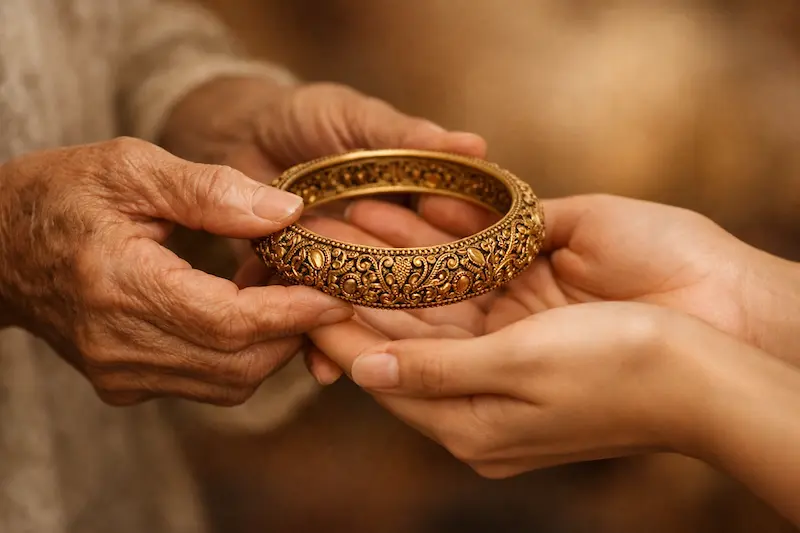
Jewellery is wearable wealth. It is used, displayed, and experienced—not just stored. It marks life events: weddings, inheritances, milestones. It carries emotional weight and social meaning. In Indian households, this takes the form of Stree-Dhan—a personal and independent reserve of wealth, historically meant to provide security beyond systems and institutions.
The Ultimate Proof of Legacy: The Inheritance Fight
Consider what happens when wealth is divided among brothers and sisters. You sit across the table and, out of pure love and affection, you might willingly take fewer ETF units so your sibling can have more. You might push a larger stack of 24K gold coins toward them without a second thought. You give them away gladly because financial assets are just numbers. One gold coin is identical to another. You don’t feel a sense of loss.
But the generosity stops the second the family locker is opened.
Brothers and sisters who would happily give away a fortune in digital or physical gold to each other will fight bitterly over one specific, worn-out traditional necklace. A person will literally leave a heavier, brand-new piece of jewellery on the table just to claim that old necklace.
Why? Because they are not calculating the 22K purity or the lost making charges.
They remember their mother wearing that exact necklace at every family wedding. They are fighting for a piece of her history. No number of gold biscuits or 24K coins bought later can ever replace that exact piece of jewellery. This friction is the ultimate proof that jewellery sits entirely outside the realm of spreadsheets. It is the purest form of legacy.
Unlike ETFs or even coins, jewellery connects wealth to the family line. It is meant to be passed down, not to be sold just because gold prices rise. It represents continuity across generations. Gold ETFs and gold coins give better returns, but they can never be equal to jewellery worn by your family. This is why jewellery survives—not because it is efficient, but because it fulfills a role that no financial product can replace.
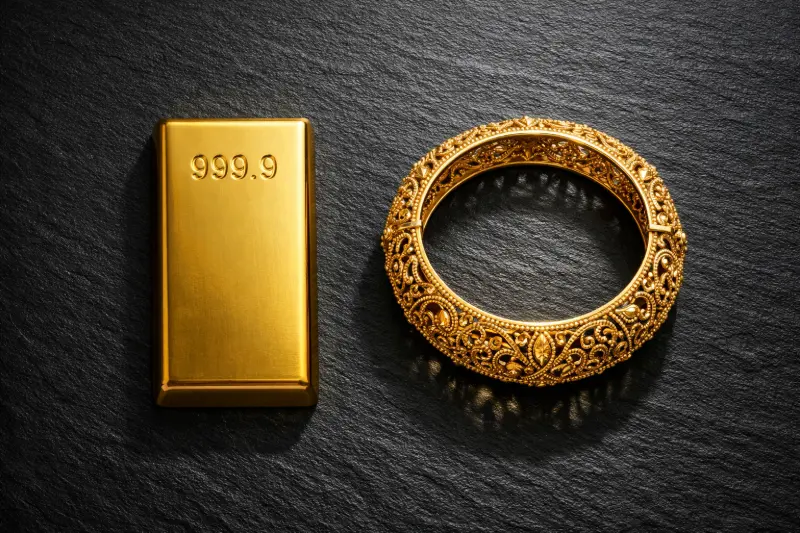
Final Verdict: Stop Mixing Investment and Wealth
So, is gold jewellery a good investment in India?
No. And it was never meant to be.
If your goal is maximizing returns, choose financial instruments like ETFs. If your goal is efficient storage, choose coins or bars.
But your goal must go beyond returns. It must be to hold something that carries meaning, memory, and permanence—Gold jewellery serves a different purpose entirely.
Think about it. What piece of jewellery from your mother or grandmother do you still hold? And what will you pass on to the next generation?
Gold jewellery will always be a bad investment. But it is powerful wealth.
Stop asking for returns on everything.
Some things are not meant to grow.
They are meant to be passed down—not sold.
Frequently Asked Questions
If gold jewellery isn’t a good investment, should I stop buying it?
No. You should stop buying it as an investment. Buy it as wealth, buy it as a legacy, or buy it for your family to wear. Just don’t expect it to perform like a spreadsheet asset. If you want pure financial returns, buy a Gold ETF. If you want something that survives a system collapse, buy jewellery.
How much “Making Charges” is acceptable for gold jewellery?
In India, making charges usually range from 8% to 25%. For plain gold jewellery, try to keep it under 10-12%. Once you go above 20%, you are paying for the “art” and the “brand,” not the gold. That money is gone the moment you leave the store.
Is 24K gold better than 22K gold for wealth?
For storage (coins/bars), 24K is better because it’s 99.9% pure. For jewellery, 24K is too soft and will break or lose shape. 22K is the standard for Indian jewellery because it balances purity with the strength needed to be worn and passed down through generations.
Can I convert my old jewellery into “Investment Gold” like coins or ETFs?
You can melt old jewellery to make coins, but you will lose the original making charges and GST. You cannot “convert” physical jewellery into a digital ETF. This is why the decision must be made at the start: Are you building a ledger (ETF) or a bloodline (Jewellery)?
Why is jewellery called “Stree-Dhan”?
Stree-Dhan refers to the absolute ownership of gold and assets given to a woman. Historically, it was her “unshakeable safety net”—portable wealth that no bank, government, or even family member could legally take from her. It is the ultimate form of financial independence.
About the Author The Hard-Asset-Architect is an everyday employee who woke up to a rigged financial system. WealthDharma exists to cut through the false narratives of paper wealth and advocate for the only real escape route: physical ownership of homes, land, and gold. Read the full ideology here.
Disclaimer: This article is provided for educational purposes only and reflects the author’s views on preserving family wealth through physical gold and silver. It is not investment, tax, legal, or financial advice, nor should it be interpreted as a recommendation to buy or sell any asset. Precious metal prices, making charges, taxes, and regulations may change over time. Always verify current information and consider your personal financial situation before making decisions. For complete details, please read our full Disclaimer.