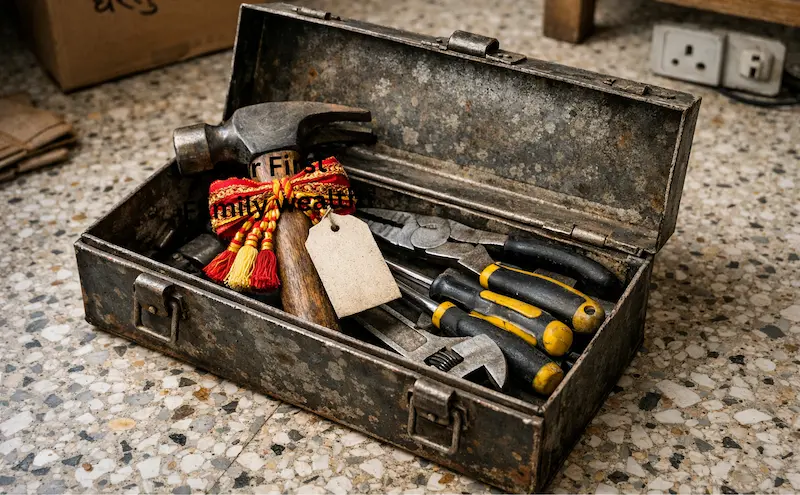
Introduction: A Gift That Carries a Philosophy
When searching for the best practical wedding gift in India, most people look at decor, envelopes of cash, or home appliances. But what if the greatest gift you could give your friend at the start of their new life isn’t about tradition or decoration — but about freedom?
Freedom from waiting three days for a service technician. Freedom from paying ₹800 for a job that takes ten minutes. Freedom from being at the mercy of a company’s helpline, a long queue of complaint numbers, and an authorised service centre that treats your time as worthless.
At WealthDharma.in, we talk about building wealth — but we believe real wealth isn’t just the money in your bank account. Real wealth is knowing how to take care of your own home. Real wealth is a neighbourhood which helps each other. Real wealth is a community where people share skills, not just greetings.
That is why a hand tool kit wedding gift means so much more than just metal and plastic. A wedding is the starting point of a new life. Gift it to a friend on that day, and mean something by it.
Every Person Should Know Basic Work Around Their Home
There is a generation being raised that cannot change a fuse, tighten a loose hinge, or hang a picture frame without calling someone. We have outsourced even the most basic skills of everyday life — and we are paying a heavy price for it, both financially and in our self-confidence.
A home comes with a hundred small tasks. Curtain rods. Cabinet handles. Moving furniture. Fixing a wobbly chair. Sealing a gap in the wall. Replacing a tap washer. None of these require an engineering degree. None of these require a professional. They require basic tools and the confidence to try.
When you gift a hand tool kit to a newlywed couple, you are not just giving them a hammer and a screwdriver. You are giving them a quiet message: “You can handle your own home. You don’t need to be helpless.”
This is the first and most important kind of financial independence at home — knowing that not every problem needs to be paid for. That lesson, learned on the first day of married life, shapes every financial decision that follows.
A Neighbourhood That Doesn’t Need an App: The Forgotten Wealth of Community
There was a time in India when neighbours knew each other. You borrowed sugar, shared tools, helped each other during repairs, and nobody kept a bill. That culture of mutual help created something economists rarely measure — community wealth.
This is what community wealth building in India looked like before platforms replaced neighbours. It was not charity. It was not barter. It was simply people living close to each other and choosing to be useful to each other.
Community wealth is not just money. It is the plumber down the street who fixes your pipe as a favour. It is the electrician neighbour who helps you understand your wiring. It is the retired engineer in your building who teaches the young couple how to use a wrench. It is trust, skill-sharing, and collective problem-solving.
When a couple owns a tool kit, they become a part and resource for their neighbourhood. They can help the elderly aunty on the ground floor fix her door latch. They can assist the young bachelor next door who doesn’t even own a screwdriver. The tool kit travels. The knowledge spreads. The community grows stronger.
This is neighbourhood wealth that no bank can store and no company can sell you.
The Corporate Service Trap: How Companies Are Fleecing Indian Consumers
Now let us speak plainly about something that affects every Indian household — the systematic exploitation disguised as “authorised service and convenience.”
It was not always like this. A decade ago, you could call any reliable local technician to service your refrigerator, washing machine, or air conditioner. They knew their job, charged fairly, and were available when you needed them. Competition kept prices honest. The mechanic built his reputation on good work. Money stayed in the community itself.
Today, that is largely gone.
Companies — especially manufacturers of white goods like refrigerators, washing machines, air conditioners, and geysers — have created a locked ecosystem. Millions of consumers are dealing with the reality of authorised service centre overcharging in India, told that their warranty is void unless they use the brand’s proprietary repair network. The standard line in every product’s customer care is: “Sorry, only authorised service centres will handle this. Otherwise your warranty will be void.” Whereas government policy is entirely different.
👉 check your white goods warranty here : https://righttorepairindia.gov.in/product-details/39
Simultaneously, app-based service platforms have inserted themselves as middlemen for even the simplest household tasks. You go to their app. You book a slot. You wait two, three, sometimes four days. The technician arrives in a branded uniform with a tablet. He taps a few things, replaces a part that may or may not have needed replacement, and hands you a bill that makes your eyes water.
Who set that price? The company did. There is no negotiation. There is no competitor offering a second opinion. The market has been closed.
The Logistical Absurdity :
Think about the madness of this system. To fix a minor issue, a home service app in India often dispatches a technician from 10 to 15 kilometres away. This skilled man is forced to battle city traffic for hours, burning fuel and wasting his most productive time, just to change a tap or check a wire. The technician is trapped in city traffic by an algorithm,
Meanwhile, there is likely a skilled mechanic three streets away from you who is sitting idle. He isn’t just a anonymous service provider; he is a crucial asset to your local ecosystem. He likely knows the specific plumbing quirks of your building and the voltage fluctuations of your sector.
When you hire this local mechanic, you aren’t just paying for a quick repair. You are making a direct investment in your own community. That money stays and circulates, strengthening the ground you walk on.
You are a “Data Harvest”
Furthermore, these systems treat you as more than just a customer — they treat you as data to be harvested. The moment you book a service through these apps or authorised portals, your personal details are fed into a marketing machine.
You aren’t just buying a repair. You are unknowingly signing up to be a “lead.” Within days, your phone and inbox are flooded with spam — insurance offers, AMC packages, and telemarketing messages. You pay a heavy financial price for a simple repair, and then you pay again with your privacy.
The Mechanic is Being Exploited Too
Here is the part of this story that rarely gets told.
The technician who comes to your home — the man who spent years learning his trade, who understands circuits and compressors and refrigerant gases — is not earning what he deserves.
Home service app commission in India is staggering. Companies operating aggregated service platforms take 30% to 40% on every job. The consumer pays more, the mechanic earns less, and the company in the middle takes the difference. He must cover his own travel, his own tools, and his own time. This is a toll-booth economy, extracting from both the worker and the homeowner.
Just check this yourself. The technician may complete a job in half an hour in your home. But you — the customer — spent almost an hour talking to customer care, logging into the app, reading emails, entering OTPs, doing ratings and reviews. An hour of your time consumed, and at the end of it, you still don’t know the mechanic’s name.
When we encourage self-reliance and community skill-sharing, we are not just saving money. We are refusing to fund this model.
👉 Read our article If you wanted to know about the hidden expenses in renting your first apartment after marriage.
The Hand Tool Kit as an Act of Financial Resistance
Seen through this lens, a hand tool kit is no longer just a practical gift. It is a quiet act of defiance. When you learn to fix your own tap, you refuse to feed the aggregator platform. When you help your neighbour, you keep money and dignity within the community. Every small repair you handle yourself is a vote against the corporate service trap. Every neighbour you help is a vote for community wealth building in India.
A good home tool kit for a new household should include:
- Claw Hammer and Screwdriver Set (Flathead and Phillips)
- Combination and Long-nose Pliers
- Adjustable Wrench (essential for plumbing)
- Tape Measure and Spirit Level
- Voltage Tester and Allen Key Set (for modern furniture)
- Drill machine (for fixing fixtures and nails)
With these tools in a small carry box, a homeowner can handle at least sixty to seventy percent of all common household maintenance tasks independently. That is sixty to seventy percent of jobs that will never go to an app. Sixty to seventy percent of commission that will never be extracted from a mechanic. Brands like Taparia, Stanley, and Bosch offer reliable quality tool kits — ₹2,000 to ₹5,000 depending on the set. These tools last twenty to thirty years if treated well. The return on that one-time investment, measured in repair bills avoided, community wealth built, and dignity preserved, is extraordinary.
A basic tool kit helps you fix small problems before they become expensive. But even the best tools cannot prevent every repair. Roof leaks, plumbing failures, electrical issues, and water damage can still result in unexpected bills. That’s why every homeowner should also build a dedicated repair fund. Read our guide on Why Every Homeowner Should Start Saving for Home Repairs Before They Happen.
What You Are Really Saying When You Gift a Tool Kit
When you hand a newly married couple a well-packaged tool kit on their wedding day, you are saying something that no greeting card can capture:
“I want you to be capable. I want your home to be one that you can take care of with your own hands. I want you to be part of a neighbourhood that creates community wealth. I DON’T WANT YOU TO BE A SLAVE OF THE CORPORATE APP ECONOMY.”
That is a profound gift. That is the WealthDharma way of thinking about wealth — not as a number in a bank account, but as the power to reject the corporate monopolies that profit from our helplessness. True wealth is the practical ability to fix what is yours, and a neighbourhood that has your back in times of need.
Financial independence at home does not begin with a mutual fund. It begins with knowing how to fix your own tap. It begins at a wedding, with a tool kit, and a friend who cares enough to say something real.
Conclusion: Small Tools, Big Philosophy
India was built by communities of people who fixed things. Who improvised. Who helped each other. Who did not wait for a service appointment to live their lives.
We can choose to return to that culture — one tool kit, one repaired hinge, one helped neighbour at a time.
The next time a friend gets married, give them something that will last thirty years, save them tens of thousands of rupees, make their neighbourhood a little stronger, and remind them that the best version of financial independence begins with knowing how to take care of what is yours.
Give them a hand tool kit. And tell them why.
FREQUENTLY ASKED QUESTIONS
Is a hand tool kit really a good wedding gift in India?
Yes — and here is why most people don’t think of it. Every new home immediately needs basic tools for furniture assembly, curtain rods, wall fixtures, and minor repairs. A tool kit is used from day one and lasts thirty years. No other wedding gift does that.
What basic tools should every Indian home have?
A hammer, screwdriver set, adjustable wrench, pliers, tape measure, spirit level, voltage tester, and Allen key set. With these eight tools a homeowner can handle most common household repairs independently. A drill bit is optional but helpful for fixing nails in the walls.
Can I use a local mechanic instead of an authorised service centre?
For repairs outside the warranty period, yes — and you should. The Government of India has launched the Right to Repair framework specifically to protect your right to use third-party repair services. During warranty period, read your warranty terms carefully before deciding.
Are home service apps exploiting mechanics in India?
The Fairwork India Report 2024 found that no major platform ensures a living wage for its workers. Platforms take 30–40% commission on every job, leaving mechanics with inadequate earnings after covering their own travel and tools.
How do I file a complaint against an authorised service centre in India?
Visit consumerhelpline.gov.in or call the toll-free number 1915. The National Consumer Helpline accepts complaints in 17 languages and forwards them to the company for resolution.
What is community wealth and how does a tool kit build it?
Community wealth is the collective capability of a neighbourhood — shared skills, mutual help, and money that stays within the local economy rather than going to corporate platforms. When households themselves owns tools and shares them with neighbours, the whole community becomes more self-reliant.
About the Author The Hard-Asset-Architect is an everyday employee who woke up to a rigged financial system. WealthDharma exists to cut through the false narratives of paper wealth and advocate for the only real escape route: physical ownership of homes, land, and gold. Read the full ideology here.
Disclaimer: The ideas expressed in this article represent the philosophy and opinions of WealthDharma. They are intended to encourage thoughtful discussion about wealth, family, responsibility, and long-term financial decision-making. This content should not be interpreted as personalized financial, legal, tax, or investment advice. Every family’s circumstances are unique. For more information, please read our full Disclaimer.