Buying gold in India is never just a transaction; it connects family continuity, cultural identity, and long-term financial security in a single transaction. Yet, most people approach it without a deliberate strategy, focusing entirely on the daily price per gram while allowing a significant part of their money to quietly leak away through making charges in gold jewellery.
At WealthDharma, we call this the “Silent Leak”. To stop this leak, you must change your mindset.
Instead of asking: “Can I reduce making charges?”
Ask: “Is this piece worth the making charges I am paying, and does it align with my purpose of purchase?”
Handled without thought, these charges reduce the real value of your holdings. Handled with clarity, they become a justified one-time fee for a lifetime of utility. This guide provides the deep-dive economics of craftsmanship you need to ensure every purchase adds lasting value to your family’s heritage.
1. What Exactly Are Making Charges?
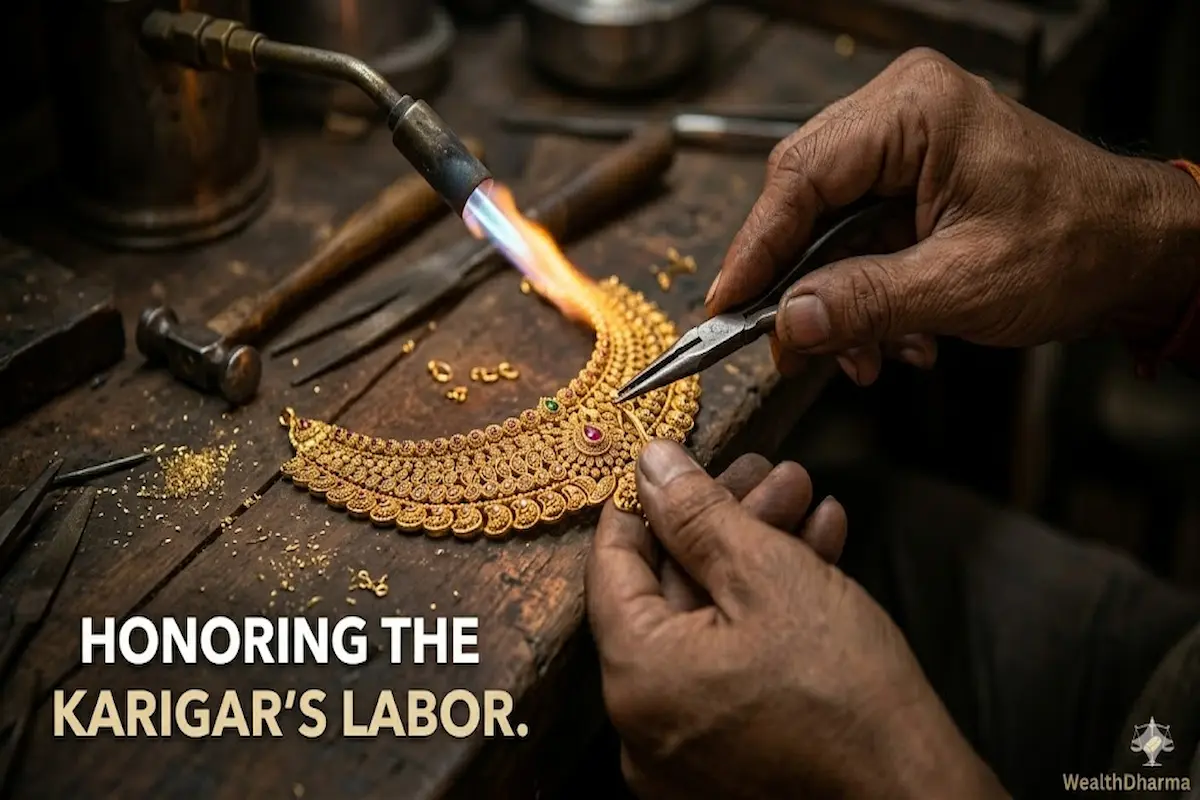
Making charges are the cost of converting raw gold into a finished, wearable piece. This fee includes craftsmanship, design, labor, and the brand value of the showroom. Making jewellery is highly laborious; it can take many days for a goldsmith to complete even a simple chain through its various processes.
In modern showrooms, these are usually calculated in two ways:
- As a percentage of the gold value (typically 6% to 15%).
- As a fixed amount per gram or per piece.
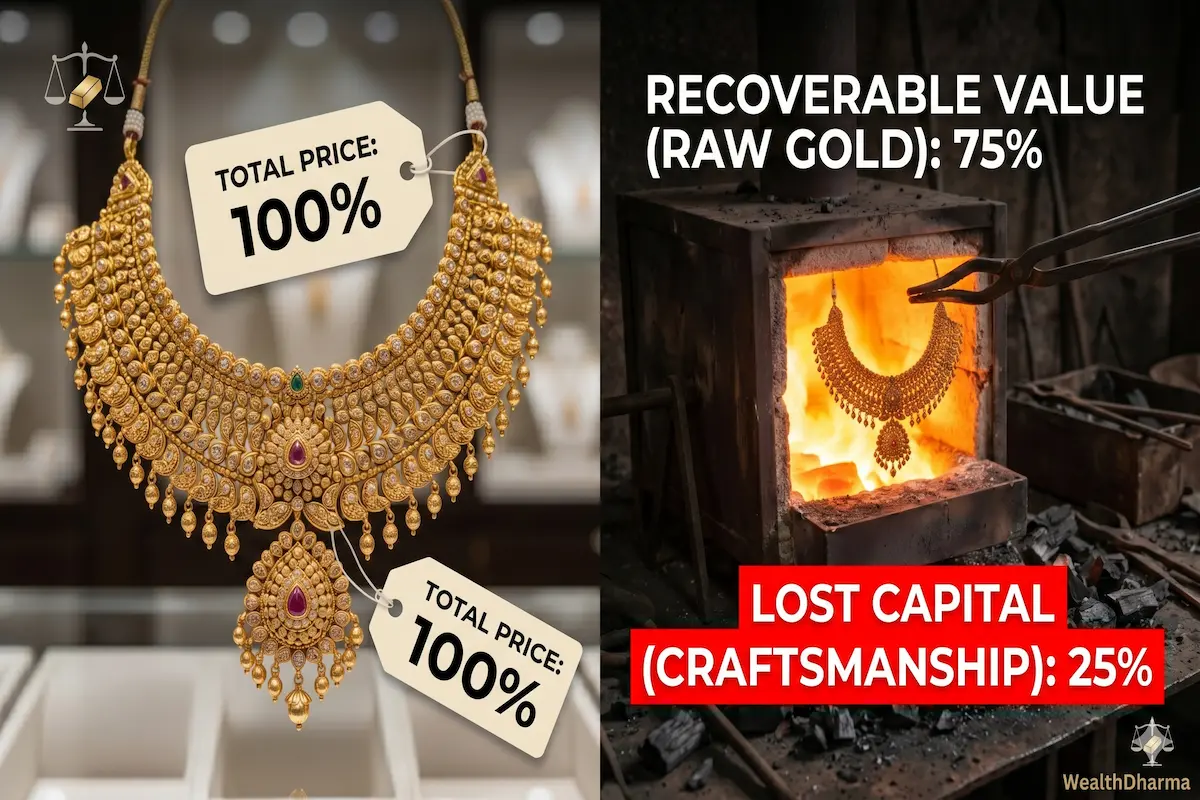
The WealthDharma Warning: Making charges are not fully recoverable when you sell or exchange the jewellery. When you liquidate your gold, buyers generally pay only for the weight and purity of the metal—the craftsmanship fee you paid simply disappears from your capital.
2. The Hidden Math: Wastage and GST
To truly understand your “Value Ratio,” you must look beyond the making charge label. Many showrooms use a more complex formula that includes “Wastage” and a split tax system.
- The Wastage (Melting Loss) Trap: Jewellers often charge for “wastage”—the gold lost during cutting, shaping, and polishing. This can range from 5% to 7% for simple designs and up to 25% for intricate patterns.
- The Dual-Tax Drain: In 2026, GST is applied as a two-part tax: 3% on the value of the pure gold and 5% on the making charges.
- The Breakeven Reality: If you pay 20% in making charges and the applicable GST, your gold value must rise by roughly 23% just for you to break even. This is why every rupee spent on excessive design is a rupee that isn’t buying actual gold grams.
3. The Value Gap: Why Making Charges Matter
Gold has a clear market value, but jewellery does not. When you purchase a piece, you pay the gold price plus making charges today, but you will only recover the gold value later. This is because the secondary market for ‘used’ jewellery is virtually non-existent; customers generally do not buy second-hand ornaments for personal use or even for gifting.
Consequently, even if your design is beautiful, the jeweller has no choice but to melt it down into raw gold to create something new. Your jewellery will eventually be melted in a furnace when you sell, causing your wealth to leak through design costs that vanish upon resale.
Wealth Leaks: If you repeatedly buy and sell jewellery pieces, your total cost increases while your resale value does not grow proportionately. Your wealth slowly leaks through design costs that vanish the moment the metal hits the furnace.
- Decision Quality: Two people spending the same amount can have vastly different outcomes: one builds durable, value-holding wealth, while the other accumulates high-cost, low-recovery items. The difference is not income; it is decision quality.
4. When to Pay More: The Value
We are not saying that high making charges are bad. These are the unavoidable costs of an extremely difficult and laborious process. Converting raw gold into a finished piece can take many days and involves significant “wastage” (melting loss) as the metal is cut, shaped, and polished.
But paying these charges should be a deliberate choice based on your long-term goals:
- Samskaras (Legacy Pieces): Wedding jewellery or traditional items involve intricate craftsmanship and carry deep emotional and cultural value. These are not mere “items”; they represent family continuity across generations. The one-time craftsmanship fee is a justified cost for a piece that adds lasting value to your family’s heritage.
- Long-Term Utility: If you are buying something you will use for many years, durability and design quality matter. Since you will be wearing it for a long time, you should choose a design that you truly like and enjoy. The design cost is spread across decades of use rather than being a recurring expense.
- The Complexity of Craftsmanship: Certain Jewellery and designs, like Temple Harams and custom necklaces, are extremely difficult to create and involve high wastage due to the complexity of the art and processes. If your goal is a unique masterpiece of Indian craftsmanship, the premium is the price for that exclusivity and the goldsmith’s skill.
Unsure about whether to buy or stop buying gold jewellery? Learn how much gold for your family is sufficient.
5. When to Avoid High Charges
There are situations where high making charges quietly work against your financial strategy and erode your capital:
- Investment Gold: If you are buying gold primarily for security, as a gift, or as a coin, you will lose the full making charges when you redeem it. For these purposes, simple, low-charge designs, coins, or bars are more suitable because they maximize the actual gold weight you own.
- Trend-Based Purchases: Fashion-driven “lightweight” designs often carry high making charges because of the specialized, delicate labor required to use less metal. These pieces lose relevance quickly and are often fragile liabilities that do not survive daily wear.
- Impulse and Urgency: Purchases driven by social pressure or festival deadlines often come with less scrutiny. When you buy in a rush, you are more likely to allow high charges to slip in unnoticed, turning a celebratory purchase into a “Silent Leak”.
- Frequent Exchanges: Exchanging jewellery for new pieces is one of the fastest ways to shrink your gold holdings. Every time you exchange, you absorb making charges and taxes a second time, effectively paying twice for the same amount of gold.
If you are evaluating making charges, it helps to see how each purchase fits into a broader system.
Start with 👉 Gold Jewellery Buying Strategy in India: The WealthDharma Framework.
6. The WealthDharma Strategy: Pay Once, Pay Wisely
Since we believe in “Buying for Life,” making charges should be a one-time cost, not a recurring one.
- Avoid “Fragile Liabilities”: Modern manufacturing allows for intricate designs at very low weight, but these are often fragile. If a piece requires a special box and cannot survive being stored in a simple pouch alongside other jewellery, it is a liability, not an asset.
- The Durability Test: Always hold the piece and check for stability under gentle pressure. Durable jewellery feels solid throughout; if it feels hollow or delicate, it is decoration, not wealth.
- Seasonal Timing: Align planned purchases with festivals like Akshaya Tritiya, when jewellers often offer genuine discounts on making charges.
7. Your Making Charges in Gold Jewellery Checklist
Before money changes hands, every purchase should clear this specific WealthDharma filter:
- ✅Purpose Alignment: Does this design serve a “Samskara” (Legacy) or “Long-Term Utility,” or is it a “Fragile Liability” or simple gift coin/bar?
- ✅Breakup: Have I asked for a detailed price breakup that separates the pure gold value from the making charges and wastage?
- ✅Calculation Type: Is the making charge a percentage of the gold value or a fixed amount per gram, and which one is more beneficial for this piece?
- ✅Resale Awareness & The 23% Rule: Do I realize that if I pay 20% in charges and 3% GST, the gold price must rise by roughly 23% just for me to break even?
- ✅Offer Alignment: Have I checked for seasonal offers (e.g., Anniversary, Akshaya Tritiya, Dhanteras) to reduce the impact of these charges on my capital?
Want to know how a jewellery scheme works, from making your monthly payments to finally buying your jewellery? Read our complete guide to jewellery gold schemes.
Conclusion: Wealth is Built by Consistency
Making charges are a decision point, not just an extra cost. Handled without thought, they quietly erode your value; handled with clarity, they become a deliberate part of a well-structured approach to wealth.
In the long run, wealth is not built by avoiding costs—it is built by making the right decisions consistently. Buy once. Buy right. Buy for life.
Frequently Asked Questions (FAQ)
Are gold making charges negotiable?
Yes. While the daily gold rate is fixed, making charges are a service fee and are fully negotiable. Do not hesitate to ask for a reduction. In most Indian showrooms, there is a margin for negotiation, especially on high-weight legacy pieces or when purchasing during off-peak seasons.
Will I get my making charges back when I sell the gold?
No. Making charges are a “sunk cost.” When you sell, the buyer only pays for the pure metal weight. The craftsmanship fee and taxes you paid simply disappear from your capital. This is the “Silent Leak” you must account for before buying.
Why are making charges higher for “lightweight” jewellery?
Lightweight jewellery requires extreme precision to ensure the piece doesn’t break. This increased labor and machine time results in a higher “per gram” charge. At WealthDharma, we often view these as “Fragile Liabilities” because you pay more for less actual metal, metal, and they are prone to denting or snapping easily under daily wear.
Does GST apply to both gold and making charges?
Yes. In 2026, GST is a two-part drain: 3% is applied to the pure gold value, while the service of “making” attracts a 5% GST. Always demand a detailed breakup to ensure you aren’t being overcharged on the tax component.
Should I buy gold coins instead of jewellery for investment?
Absolutely. If your goal is financial security or “hard asset” accumulation, gold coins and bars carry much lower making charges (often 1% to 3%). This allows you to own significantly more gold grams for the same rupee investment.
About the Author The Hard-Asset-Architect is an everyday employee who woke up to a rigged financial system. WealthDharma exists to cut through the false narratives of paper wealth and advocate for the only real escape route: physical ownership of homes, land, and gold. Read the full ideology here.
Disclaimer: This article is provided for educational purposes only and reflects the author’s views on preserving family wealth through physical gold and silver. It is not investment, tax, legal, or financial advice, nor should it be interpreted as a recommendation to buy or sell any asset. Precious metal prices, making charges, taxes, and regulations may change over time. Always verify current information and consider your personal financial situation before making decisions. For complete details, please read our full Disclaimer.