- The Illusion of Discounts: Buying an under-construction flat isn’t a smart investment; you are trading your most valuable asset—your time—for a glossy brochure and massive risk.
- The Brand Name Trap: Mega-builders use shell companies. If a project stalls, the famous parent company’s brand logo won’t save you from a decade in civil court.
- The Banking Reality: To the bank, you aren’t a homeowner. You are just a guaranteed EMI machine used to bail out a billionaire builder’s debt.
- The Verdict: Paying a 10–15% premium for a completed, Ready-to-Move apartment is not a financial loss; it is the necessary cost of keeping society’s chaos out of your family’s home.
The Reality of the Real Estate Market
Most homebuyers compare prices when choosing between a Ready-to-Move-Apartment vs under construction. I compare risks. I would rather pay a premium for a completed home than expose my family to delays, uncertainty, and promises that may never be fulfilled. Society loves a discount, and people are convinced that buying under-construction house means outsmarting the market for a lower price. Real estate companies feed this illusion with “pre-launch” offers, early-bird discounts, and massive marketing blitzes—and the banks are right there cheering them on.
But here is the reality: when you buy an under-construction flat, you are not buying a home. You are buying a glossy brochure, a promise, and a massive amount of risk. We have to wise up about how society operates. Some people might get lucky rolling the dice on these projects, but that does not mean you follow them blindly. We have to conserve and capitalize on the one real asset we have: our time. If you don’t take action within your time, society will not spare you. You are trading your most valuable asset for a gamble.
Let’s break down the reality of what is actually happening. Depending on what you want to buy, you are generally looking at two options: a stand-alone apartment or a large gated community.
Stand-Alone Apartments
These usually contain 40 to 70 flats. Because they are smaller, these builders normally don’t advertise massive pre-launch offers. They tie up with banks for financing and sell outright to buyers. They will, of course, offer some discounts if you book while they are still laying the bricks.
Large Gated Communities
The construction time for these giants is easily six to seven years. They operate on a hub-and-spoke model. They finish and sell one tower, and then use that money to start the second tower. They keep repeating this cycle until the project is done. The completed first tower gives new buyers the feeling that the whole project is a sure thing.
This method means the builder doesn’t need heavy capital upfront to finish the whole project. They use the sale proceeds from the early buyers to fund the rest. That is exactly why they do extensive marketing and push RERA discounts, New Year discounts, and anniversary offers for the first two or three years. They desperately need your upfront capital to purchase the land, get permissions, and keep the construction moving.
Yes, you might get a flat at a “reasonable” price on paper. However, the risks you are swallowing are dangerously high.
The Brutal Risks of Under-Construction vs. a Ready-to-Move-Apartment
Let’s talk about the stand-alone projects first. These are normally constructed near residential areas on small land parcels (500 to 2000 sq yards). If a small builder finds a good piece of land, they enter into a development agreement with the landowner and start digging. As small players, they can’t afford the middle of the city, so they go to adjacent villages or towns a few kilometers off the main road.
If demand picks up—usually because the government announces a new office or highway—they will finish the job. But what if the demand doesn’t meet the builder’s expectations? What if the flats don’t sell out? The builder will simply cut corners and leave the project half-baked. If the plan had two lifts, he will only install one. He won’t install CCTV cameras. He will slap on a single coat of paint and disappear.
Worse is the greed. Look at what happens with municipal approvals. These small builders get permission for four floors but build a fifth floor illegally just to squeeze out extra profit. They sell it to you at a “discount.” Then, the municipal corporation refuses to give the Occupancy Certificate (OC). They cut the power and water connections, or worse, they bring a bulldozer. Suddenly, your life savings are locked inside a building that doesn’t legally exist, and the builder has already switched his phone off. You and the other buyers are left forming an association to fight a ghost.
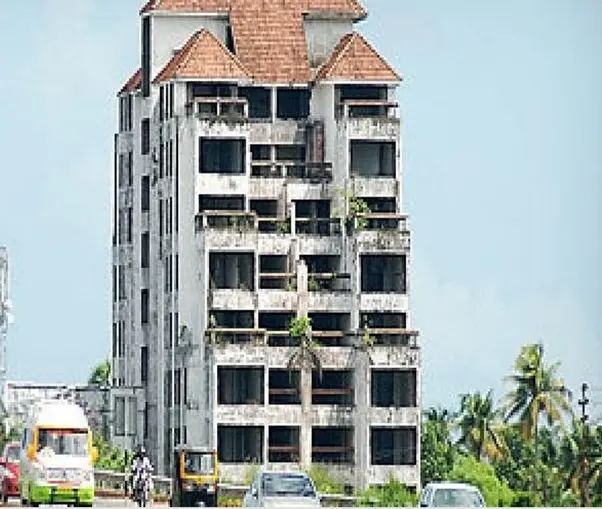
Then, there is the landowner dispute risk. In India, land disputes are a generational sport. Documents are notoriously opaque. A builder signs a Joint Development Agreement (JDA) with a landowner and starts digging. Two months later, the landowner’s estranged brother or sister wakes up and files a partition suit in civil court claiming a share of the ancestral land. The court issues a stay order. Construction stops immediately. That stay order will drag for ten to fifteen years in the Indian judicial system. Your money—and more importantly, your time—is trapped in a frozen concrete skeleton because of a family fight you have absolutely nothing to do with.
Finally, there are partnership disputes. These small projects are usually done by two or three partners with sloppy paperwork and zero compliance with the Companies Act. If they fight over profit sharing, capital infusion, or if one partner passes away, the project stalls entirely.
Don’t believe me? Just look at the hard data. According to a recent report by real estate analytics firm PropEquity, covered by The Economic Times, nearly 2,000 housing projects comprising over 5 lakh units are sitting stalled across 42 Indian cities. We are talking about thousands of crores of public money trapped in concrete skeletons. Nobody knows who owns them, why they stopped, or if they will ever be finished.
The Illusion of Large Gated Communities
People think large gated communities are safer because they are built by big companies with massive ad budgets. That is a fatal mistake. Because the projects are bigger, the risks are bigger. Every risk that exists for a stand-alone apartment exists here, plus a few more.
Whenever a salesman hands you a brochure, look at the company name. They will tell you, “This is built by the famous ABC Group.” But look closer. The name on the actual legal contract won’t be the parent company. It will be “ABC Private Limited” or “ABC Specific Builders.” Why? Because they establish a separate shell company for each project.
We don’t know the financial capability of this new company. How do they just get to use the old, reputed brand name? Does the famous parent company stand as a guarantor if this new project fails? Do you think this operates like Tata Sons, where the parent ensures their subsidiary companies don’t fail? Is that the case here? We don’t know, but usually, it is a flat NO. If you ask the sales team who the actual legal owner is, and who will be personally responsible if the company goes bankrupt, they will suddenly lose their voice.
You think a big brand name saves you? You think their flashy ads mean your money is safe? Look at the Amrapali Group or Unitech. They had the biggest cricketers doing their ads and glossy full-page spreads in every newspaper. People blindly bought into the brand. What happened? The management siphoned off the money to other shell companies. The Supreme Court had to step in, the directors went to jail, and over 40,000 buyers spent a decade bleeding in courts instead of living in their homes. When the ship sinks, the brand logo on the brochure won’t keep you afloat.
Furthermore, these massive projects worth hundreds of crores are rarely listed on the stock exchange. There is zero public accountability. With a stand-alone builder, you can at least catch him by the collar. With these mega-builders, you can’t even get past the security guard at their corporate office.
The Ultimate Trap: Banking Risk
How is a bank a risk? Ask yourself: is the bank lending money to you, or to the builder? If they are lending to you, the money should enter your account for you to pay the builder as construction progresses. But that is not what happens. The bank says, “We are lending to you, but we will disburse the funds directly to the builder.”
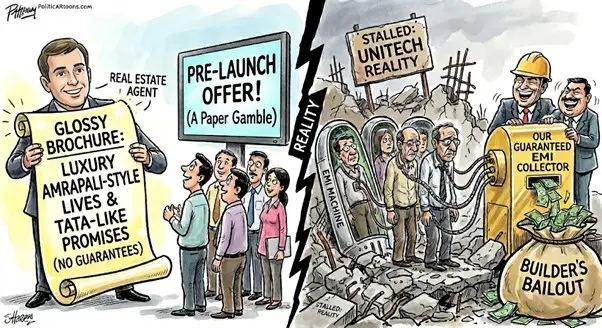
Why? Because these builders are influential people with money and power. They already owe the banks massive sums for the initial construction loan. The banks want to reduce their own risk. When a retail customer walks in for a home loan, the bank jumps in happiness. They aren’t giving out new money; they are just transferring your loan amount directly into the builder’s loan account to settle the builder’s debt. The bank’s risk to the builder goes down, and your risk goes up. Make no mistake—to the bank, you aren’t a homeowner. You are just a guaranteed EMI machine to bail out a billionaire builder.
If the project gets stuck, the bank doesn’t care. The crisis got so out of hand that the Government of India literally had to step in and create a massive ₹15,000 crore SWAMIH Fund just to try and rescue lakhs of stranded homebuyers from these failed projects. Even with government intervention, they are only managing to deliver a fraction of those homes.
Meanwhile, the banks simply continue to deduct the EMI from your salary every single month. They know you are weak and they can get their money anyway. Look at the Jaypee Infratech disaster in Noida. The flats were caught in massive legal and insolvency troubles, yet banks shamelessly kept deducting EMIs from thousands of middle-class customers. The banks know the builder can hire a 20-crore lawyer and drag a case out for 30 years. You can’t. Your salary account, PF, mutual funds, and insurance are all tied to the bank. If you stop paying, they freeze your balance. You have no choice.
Why Do People Still Buy Under-Construction Property?
I am not saying no one should ever book one. But you need to know why you are doing it. The people who do this fall into two categories:
- Traders: These people book a one-crore flat by paying a token advance of 10 or 15 lakhs. They know the risks. Once the construction picks up speed a year or two later, they sell their booking for a profit. They are seasoned speculators. They know the markets, and if they take a loss on one project, they will recover it on the next transaction.
- Misguided Customers: These are regular people who believe a finished flat is too expensive and book under-construction to get a “cheaper” price. Let’s look at the reality. Say the current under-construction price is Rs. 7,000 per square foot. Construction takes 3 years. After 3 years, how much is this going to be? Not more than Rs. 8,500. If you didn’t take a bank loan and kept your money in a fixed deposit, or if you calculate the heavy interest you paid to the bank on your EMIs during those 3 empty years, the cost is practically the same. You just don’t notice the effect of those three years because you are paying it slowly.
👉 Read Next: The Brutal Truth About Buying an Apartment: What You Must Check Before Signing
My Personal Thinking: Why I Only Buy a Ready-to-Move Apartment
My thinking is simple. When I buy a flat, I am not buying a lottery ticket. I am buying a home where my family may live for 20 or 30 years.
For such a decision, saving 10–15% at the beginning is not the most important thing. Peace of mind is more important. When the apartment is already completed, you can see everything with your own eyes:
- The actual construction quality.
- The functioning lifts.
- The real parking situation.
- The actual water facilities.
- The established neighbourhood.
- How people are already living there.
There are no promises. There are no brochures. There are no future plans. Everything is already visible.
Yes, the price may be slightly higher. But in return, you remove many risks that are completely outside your control. In real estate, many people chase discounts. I prefer certainty.
That is why whenever possible I prefer buying a ready-to-move apartment — even if it costs 10–15% more. Because in the long run, safety is always cheaper than risk.
Frequently Asked Questions
Why are under-construction apartments considered a massive financial risk?
Buying an under-construction flat isn’t a smart investment; you are trading your most valuable asset—your time—for a glossy brochure and massive risk. If a builder cuts corners or faces disputes, your money becomes trapped in a frozen concrete skeleton. You are essentially buying a lottery ticket instead of a secure home that protects your family from society’s chaos.
Does a famous builder’s brand name guarantee project completion and safety?
No, the famous parent company’s brand logo won’t save you from a decade in civil court if a project stalls. Mega-builders establish a separate shell company for each project to limit their liability, leaving buyers with zero public accountability. When the ship sinks, the flashy ads and brand logo on the brochure won’t keep you afloat.
Are bank home loans for under-construction flats safe for the buyer?
Absolutely not; to the bank, you aren’t a homeowner, but a guaranteed EMI machine used to bail out a billionaire builder’s debt. The bank disburses the funds directly to the builder, effectively transferring your loan to settle their debt while your personal risk skyrockets. If the project halts, banks will shamelessly keep deducting EMIs from your salary, knowing you have no choice.
Why do buyers still fall for under-construction pre-launch offers?
People are convinced that buying under-construction means outsmarting the market for a lower price, falling for the illusion of a discount. While seasoned traders might flip these pre-launch offers for profit, misguided customers fail to calculate the heavy interest paid to the bank during empty years. Ultimately, the final cost is practically the same, but the buyer absorbs years of unnecessary vulnerability.
Is paying a premium for a ready-to-move apartment a financial loss?
No, paying a 10–15% premium for a completed, Ready-to-Move apartment is not a financial loss. It is the necessary cost of keeping society’s chaos out of your family’s home and securing immediate peace of mind. In the long run, securing a tangible, hard asset with zero legal ambiguity is always cheaper than absorbing the brutal risks of a stalled project.
About the Author The Hard-Asset-Architect is an everyday employee who woke up to a rigged financial system. WealthDharma exists to cut through the false narratives of paper wealth and advocate for the only real escape route: physical ownership of homes, land, and gold. Read the full ideology here.
Disclaimer: This article is intended for educational and informational purposes only. It reflects general financial principles and the author’s views on home ownership. It should not be considered legal, tax, financial, or real estate advice. Every family’s financial situation is different. Please evaluate your own circumstances and consult a qualified professional before making significant financial decisions. For additional information, please read our full Disclaimer.