A Practical Guide to Gold Buying That Fits Your Family’s Real Needs
Introduction: Why There Is No Single Number
When people search for how much gold jewellery is enough for a family, they expect a number. Ten tolas. Fifty grams. A fixed benchmark.
But the honest answer is : there is no universal number.
What makes sense for one family may be excessive for another. And what seems modest in one context may be entirely appropriate in another.
The right quantity depends on five things:
- Family customs and traditions
- Financial capacity at this point in life
- Life stage — what lies ahead for the family
- The intended purpose of each piece
- The broader context of where and how the family lives
This is not simply a question of quantity. It is a question of fit.
| “A sensible amount is one that fits a family’s broader wealth structure — without disturbing the creation of other enduring wealth.” |
What Does ‘Enough’ Actually Mean for a Family?
The idea of enough is rarely a fixed number. It is a threshold that differs by household — and changes over time.
For one family, enough may be modest: a few pieces for daily wear and something set aside for a daughter’s wedding.
For another family — with broader customs, greater means, and generational traditions — a larger accumulation may make complete sense.
The point is not to imitate what others hold. The point is to arrive at a level that is genuinely appropriate for your own family.
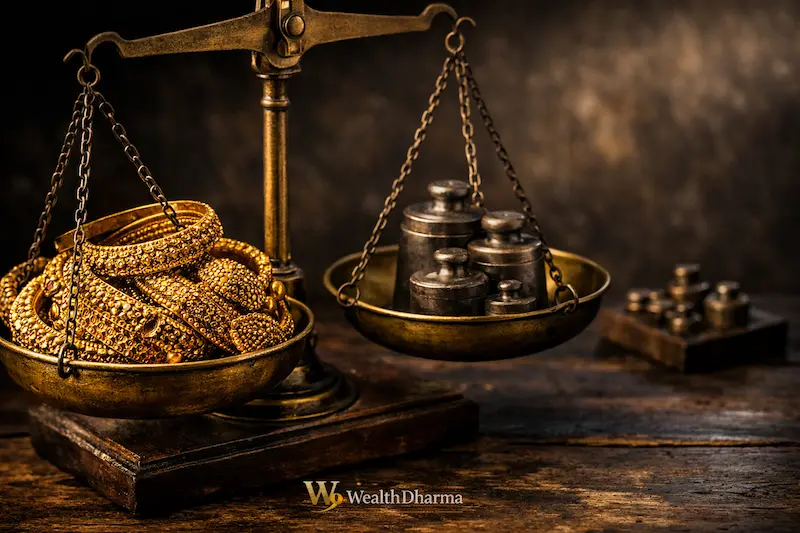
Four factors shape this threshold in practice:
- Customs followed in the family
- Financial means available without strain
- Responsibilities ahead — weddings, children’s education, housing
- How gold fits into the family’s broader wealth plan
A Three-Part Test Before Buying More Gold
Before increasing jewellery holdings, apply this simple three-part test:
1. Does it fit family customs?
Is this purchase aligned with genuine family practice — or is it driven by comparison with neighbours, relatives, or social pressure?
2. Does it fit financial means?
Can it be acquired without weakening savings, housing goals, education funding, or productive investment activity?
3. Does it fit long-term use?
Will it serve a lasting purpose — or is it being bought without a clear, defined need?
If a purchase fails one or more of these tests, it may not make sense — regardless of how much others in the family have accumulated.
| “These three questions often provide more clarity than trying to arrive at a target quantity alone.” |
The Legal Definition of ‘Enough’: Income Tax Safe Zones
While you are deciding what is culturally or financially enough for your household, the Indian Income Tax Department has its own clear definition.
From a strictly legal standpoint, there is no upper limit on the amount of gold jewelry you can own in India, provided it is acquired through declared, legitimate income or documented inheritance.
However, under the Central Board of Direct Taxes (CBDT) guidelines, tax authorities establish a “seizure exemption threshold.” This is the amount of physical gold jewelry a family can hold at home without needing to produce purchase bills, invoices, or inheritance records during a tax assessment:
- Married Woman: Up to 500 grams (approx. 43 tolas)
- Unmarried Woman: Up to 250 grams (approx. 21 tolas)
- Male Member (Married or Single): Up to 100 grams (approx. 8.5 tolas)
Two Critical Ground Rules for the Asset Holder:
- Jewelry vs. Bullion: This safe-zone exemption applies strictly to jewelry and ornaments. It does not protect gold coins or bars. If you are accumulating physical gold in raw brick or coin form, you must maintain a pristine paper trail (invoices or specific mention in a Will), regardless of the weight. Unexplained gold can be slapped with steep taxes and penalties totaling up to 78%.
- Exceeding the Limit is Not Illegal: If your family holds 1,500 grams of jewelry but the CBDT collective threshold for your household members is 950 grams, the remaining 550 grams is entirely legal if you can explain it. Legitimate explanations include formal inheritance, gifts received during marriage, or purchases made through accounted bank transfers/UPI.
For a hard-asset builder, the goal is simple: construct your family’s gold layers with the peace of mind that your physical wealth is backed by clean accountability. Read our Gold Jewellery Buying Strategy in India to under stand the WealthDharma Framework.
Think in Layers, Not One Total Amount
One of the most practical ways to approach gold is to think in layers rather than trying to arrive at one total number.
| Layer | Category | Examples |
| Layer 1 | Essential / Daily Wear | Thin chain, small earrings, bangles |
| Layer 2 | Occasion Jewellery | Wedding sets, festival pieces |
| Layer 3 | Legacy Jewellery | Heirlooms, stridhan, long-held pieces |
Each layer serves a different function. A family can build each layer gradually, at its own pace, without the pressure of trying to reach an undefined total.
Context Matters: Urban and Rural Needs Can Differ Significantly
An important factor that is often overlooked is that need varies — even when income is similar.
Two families earning the same household income may arrive at very different levels of gold jewellery — and both can be reasonable.
Consider a common example from India:
| Urban Family (e.g., Delhi, Mumbai) | Rural / Semi-Urban Family |
| Minimal daily wear preferred (thin chain, small studs). Driven by safety, workplace norms, urban practicality. | Two or three chains, broader daily-wear holdings may be common. Driven by local customs, social norms, and patterns of use. |
Neither family is necessarily excessive or prudent. They are simply responding to their own context. This is why the question of how much gold jewellery makes sense for a family cannot be answered by income alone.
When a Purpose Has Been Met, More May Not Be Needed
Gold is often bought for specific purposes — daily use, a wedding, a particular custom, or a long-term family holding. Once a purpose has been reasonably fulfilled, continued buying for that same purpose may not always be necessary.
A common example:
| If jewellery intended for a daughter’s wedding has already been substantially provided for, further purchases for that same purpose need a separate, new justification — not simply that accumulation has become a habit. |
This is often where ‘enough’ begins for a family — not at a fixed weight or value, but at the point where an original purpose has been met.
Gold Can — and Should — Be Built Slowly Over Time
Another common mistake is assuming gold accumulation must be completed in one phase of life.
For most families, there is no need to rush. Gold is a long accumulation process. It does not have to be completed in one year, or even in five.
A practical approach that works across income levels:
- Acquire one piece now when finances comfortably allow
- Add another piece later as the family’s situation improves
- Expand holdings only when doing so does not create financial strain
| “Gold may be accumulated over a lifetime. It does not have to be finished in a hurry.” |
Crucially, this gradual accumulation should happen without hindering:
- Household savings and emergency reserves
- Equity or mutual fund investment activity
- Home ownership or housing goals
- Farmland or other productive assets where relevant
- Children’s education funding
Gold should grow alongside other wealth — not crowd it out.
A Cultural Note: Stridhan and Purpose-Based Buying
In many Indian families, jewellery acquired for a daughter’s marriage is viewed as serving a distinct and important purpose — often connected to the tradition of stridhan, traditionally regarded as a woman’s personal wealth and security.
This cultural practice illustrates an important principle: purpose drives buying.
When that purpose has been substantially addressed, further accumulation may need stronger justification. This does not mean additions are never reasonable — it means they should be anchored to a real purpose, not continued out of habit or social pressure.
Gold Is Part of Family Wealth — Not All of It
Gold holds cultural, practical, and financial value for Indian families. But it is only one part of a family’s total wealth picture.
A complete wealth structure for most families also needs:
- A home — the most common long-term asset
- Farmland or productive land where applicable
- Education for children
- Emergency reserves — typically three to six months of expenses
- Long-term investment assets: equity, mutual funds, PPF, or similar
A useful guiding principle to carry through all gold-buying decisions:
| “Build gold in a way that does not disturb the creation of other enduring wealth. That principle, by itself, answers many ‘how much is enough’ questions.” |
Quick Decision Guide: When to Buy More Gold and When to Pause
- ✔ Additional Gold May Make Sense When:
- It fits genuine family customs
- It serves a clear and current purpose
- Core financial priorities are already funded
- It can be added gradually without financial strain
- It does not delay housing, education, or investment goal.
- ⚠ Pause and Reflect When:
- The original purpose for buying has already been fulfilled
- Buying is being rushed to quickly “complete” holdings
- It weakens savings, investments, or emergency reserves
- It is driven by comparison rather than genuine need
- It crowds out other wealth-building priorities
Conclusion: Fit, Not Formula
There is no universal answer to how much gold jewellery is enough for a family. But there is a reliable way to think through the question:
- Apply the three-part test: custom, means, and long-term use
- Think in layers — essential, occasion, and legacy
- Recognise that context shapes need: urban and rural families may reasonably differ
- Stop buying for a purpose once that purpose has been fulfilled
- Build gradually — gold does not need to be completed in one phase of life
- Ensure gold grows alongside other wealth, not at its expense
The goal is not to reach an ideal quantity. The goal is to hold an amount that fits the family wisely — and to know, with confidence, when enough is enough.
FREQUENTLY ASKED QUESTIONS
How many grams of gold is ideal for a middle-class Indian family?
There is no fixed ideal. A family in an early stage of life may have modest holdings of 50–100 grams. A family with multiple women, several decades of accumulation, and a completed wedding cycle may have significantly more — and both can be appropriate. What matters is not the gram weight but whether it was acquired with clear purpose, without disturbing other financial priorities.
Is buying gold jewellery a good investment?
Gold jewellery has cultural, emotional, and practical value — but it is not a pure financial investment in the way equity or real estate is. Making charges (typically 10–25%) are paid at purchase and not recovered at resale. The gold itself holds value and tends to preserve purchasing power over long periods, but the jewellery form adds costs that reduce financial efficiency. For families, the right framing is: jewellery serves purpose and culture; financial gold exposure is better achieved through Sovereign Gold Bonds or gold ETFs if that is the goal.
What is the income tax exemption limit for gold jewellery in India?
Under current Indian income tax rules, there is no tax at the time of holding jewellery. Capital gains tax applies on sale. Certain limits apply to the amount of undeclared jewellery that tax authorities are permitted to seize during search operations — 500 grams for a married woman, 250 grams for an unmarried woman, and 100 grams for a male member of the family. These are search seizure limits, not investment benchmarks.
Is it better to buy physical gold jewellery or gold bonds?
No. Jewellery and financial gold instruments serve completely different purposes and should not be compared. In Indian families, much of the jewellery held by women is STRIDHAN — a cultural and legal obligation, not a financial choice. SGBs and Gold ETFs are financial instruments and belong in a comparison with mutual funds, debt funds — not with physical jewellery.
About the Author The Hard-Asset-Architect is an everyday employee who woke up to a rigged financial system. WealthDharma exists to cut through the false narratives of paper wealth and advocate for the only real escape route: physical ownership of homes, land, and gold. Read the full ideology here.
Disclaimer: This article is provided for educational purposes only and reflects the author’s views on preserving family wealth through physical gold and silver. It is not investment, tax, legal, or financial advice, nor should it be interpreted as a recommendation to buy or sell any asset. Precious metal prices, making charges, taxes, and regulations may change over time. Always verify current information and consider your personal financial situation before making decisions. For complete details, please read our full Disclaimer.