Core Truth : Buying an apartment is a long-term decision, not a brochure-driven purchase. This buying an apartment checklist cuts through marketing noise and explains what truly matters—location, apartment size, land ownership, legal documents, builder risks, UDS, and occupancy certificates.
You are enlightened.
You have realised the truth — you need a home of your own.
Or maybe you are one of those rare geniuses who understands a simple truth: phones, cars, SIPs, gadgets… none of that matters if you don’t have a roof that is truly yours.
So you decided: to Buy an Apartment.
Good. A grounded, sensible decision.
But the moment you start looking, you collide with the corporate façade.
Suddenly you enter a strange world where every gate is “Premium Living” and every building is “Luxury Residences.”
The marketing machinery is in full swing. Every brochure is a calculated distraction — glossy colours showing smiling families, green lawns, infinity pools, and children flying kites in a permanent sunset.
It looks flawless.
It is designed to make you fall in love with a dream so that you forget to inspect the foundation.
Behind those polished brochures and hollow promises are the things the “sales experts” deliberately hide — shady documentation, bypassed approvals, structural shortcuts, and legal traps that can chain your family to problems for the next 30 years.
So before you fall in love with a photograph of a swimming pool, halt.
Look at the ground beneath your feet.
1 BHK, 2 BHK, 3 BHK – Decide Your Real Requirement
The first thing you must decide is your actual requirement and affordability, both for today and the future.
Do you need a single bedroom, double bedroom, or triple bedroom apartment?
Don’t talk to me about marketing gimmicks—1.5 BHK, 2.5 BHK, or ‘studio magic.’ Those are just tricks to sell you a small space at a big price.
The biggest drawback of an apartment is :
you cannot add another room later.
Even if your income increases, even if your family grows — the structure will not change.
For example, if you have two children — one girl and one boy — you will eventually need a separate room for the girl.
This is not a luxury. It is a basic requirement of dignity and privacy. So plan a separate room for the girl from the beginning.
Many buyers ignore this today and regret it ten years later.
Many buyers make a common mistake. They say:
“Our children are small. They are in 3rd or 4th class. All of us can sleep in one room. Why waste money on extra rooms?”
So they buy a bigger hall, bigger dining space, bigger TV cabinet area, but fewer bedrooms.
Ten years later, they realise the mistake.
If you can afford only a 650 sq ft 1 BHK, try stretching slightly and buying an 800 sq ft 2 BHK with a smaller hall size instead.
Even if the second room is small, it will become valuable later.
First fulfil functional needs — number of bedrooms.
Only after that should you worry about bigger halls, bigger dining spaces, or TV Cabinets.
Before finalising anything, visualise the plan of your future apartment yourself.
Think about how your family will actually live there.
Location of the Apartment
Builders often construct apartments in interior areas where land is cheap and easily available.
Lower land cost means they can advertise lower flat prices and sell faster.
The builder is not your friend. He isn’t thinking about your life; he’s thinking about his margins.
Keep this in mind.
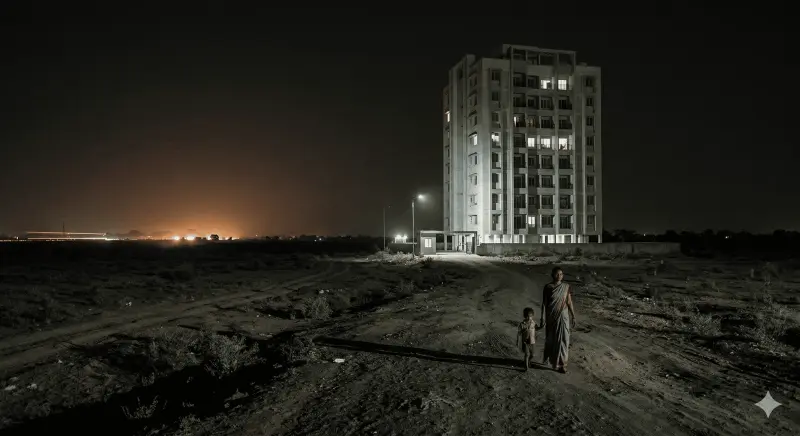
An apartment should ideally be located near a main road in a proper residential area.
Why?
Because your family should be able to move freely even at night. Otherwise the apartment becomes a jail for your family.
If your apartment is near a main road:
• Children can easily go to school.
• Your spouse can take them to parks, classes, or activities.
• Groceries and basic needs are accessible.
• Hospitals and pharmacies are nearby.
Your family should not depend entirely on you driving them everywhere just to live a normal life.
There is another advantage.
If the apartment is in an active residential area, your spouse may also be able to:
• run a small home business
• take up part-time work
• or build a local network
This is very common and much easier in well-located residential areas.
The quality of life becomes much better.
So do not judge the project by the quality of brochures.
Brochures do not decide quality of life.
Location of Apartment decides the quality of life.
👉 Read Next: The Ultimate Reality of Wealth: Why You Must Own a Home First
Land Documents and Land Ownership
Now we come to one of the most dangerous areas: land ownership and documentation.
First check the total land area of the apartment project, including boundary walls.
Many builders do the following trick.
They purchase only the land where the main building towers stand.
Then they encroach surrounding land for:
• setbacks
• boundary walls
• parks
• internal roads
And they show the entire area in the brochure as part of the project.
That is why you often see apartments constructed beside:
• lakes
• rivers
• river fronts
• government land
• temple lands (devasthanam lands)
Builders quietly occupy adjacent land by simply building a boundary wall.
Now comes the scary part.
Even a government or chief minister cannot regularise some of these lands, because they belong to lakes, rivers, temples, or other protected categories.
Even after 30 or 50 years, if the government decides to reclaim the land or a court case arises, you and your children will face the consequences.
And fighting a legal battle is extremely difficult, because the entire apartment association must fight together.
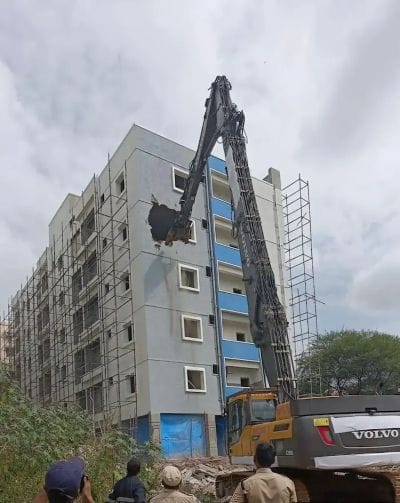
Do you think this is fear-mongering?
Look at what happened in Hyderabad.
Many apartments were constructed on encroached lake areas and drainage channels decades ago. When floods started becoming severe, the administration began clearing those encroachments.
Some of those buildings had even received official permissions earlier.
But if the land never belonged to the builder, how could the permission itself be valid?
A similar situation happened in Uttarakhand, where homes were built on railway land and sold to buyers. Entire settlements on encroached land were later removed after court orders — as seen in the Haldwani demolitions (2024).
After many years, the railways moved to reclaim the land for infrastructure projects.
If you think, “Nothing will happen after 20–30 years,” look at what happened here. Living somewhere for 30 years does not make illegal land legal.
A train cannot fly over your apartment.
It has to pass through that land.
The builder is long gone.
You are left with the problem.
So what should you do?
Assess the Project Area.
First physically assess the total project area. Then verify whether the builder actually owns that entire land.
After that:
• check the link documents for the full project land
• obtain an Encumbrance Certificate (EC) from the registrar office yourself
Do not rely on documents given by the salesman. Spend some money and verify independently. If there are nearby villages, quietly ask a local real estate broker or local residents about the land history.
At this stage, do not waste time looking at interiors or model flats.
Land ownership comes first and foremost.
Ownership of the Company Selling the Flats
Let us understand how apartments are actually built.
There are two broad types:
- Standalone apartments
- Mega gated communities
Both have risks.
Standalone Apartments
Standalone apartments usually contain 30 to 70 flats.
Most buyers assume the builder bought the land and is constructing the building.
In many cases, that assumption is wrong.
What usually happens is this:
The builder identifies a piece of land owned by someone. Instead of buying the land outright, the builder signs a development agreement with the landowner.
Under this arrangement:
• The landowner contributes the land.
• The builder contributes construction.
• After completion, the flats are divided between them.
Typically the landowner receives 40–50% of the flats, and the builder sells the remaining flats to buyers.
If everything goes smoothly, the project finishes within one or two years, the builder sells his share, and moves on to another project.
But if something goes wrong, the buyer is the one who suffers.
Here are the risks you must understand.
Risk 1
Disputes Between Landowner and Builder
If a dispute arises between the builder and the landowner during construction, the project can suddenly stop.
The landowner has not invested construction money. His land is still there.
The builder may have already taken loans and sold several flats.
If the relationship breaks down, the builder may simply walk away, leaving buyers stuck with a half-finished building.
So you must check the development agreement between the builder and landowner.
Understand:
• Who owns the land.
• What percentage of flats belong to the landowner.
• Whether the builder has full construction rights.
Risk 2
Land Mortgaged to Banks
Another common situation is this.
The builder mortgages the land or project to a bank to raise construction finance.
If the builder defaults or the project faces legal trouble, the bank has the legal right to auction the property to recover its money.
The buyers then enter a long legal battle.
So always check whether the land or project is mortgaged to any bank or financial institution.
This information can be verified through the Encumbrance Certificate (EC).
Risk 3
Builder Partnership Disputes
Many small construction companies are formed by two or three partners.
Everything works well in the beginning.
But once the project reaches 60–70% completion, money issues start appearing.
Partners begin fighting about profits, expenses, and remaining work.
Sometimes one partner walks away.When that happens, construction slows down or stops completely.
So check:
• Whether the project is being developed by an individual builder or a registered company
• Whether the company has clear ownership and financial structure
If the project is run by a loosely formed partnership, the risk is higher.
The Point You Must Understand
When you buy an apartment in a standalone project, you are not just trusting the building.
You are trusting:
• the builder
• the landowner
• the agreements between them
• and the financial stability of the project.
If any one of these pieces breaks, the entire project can collapse.
That is why you must investigate these things before looking at tiles, wardrobes, or modular kitchens.
Mega Gated Communities
Many buyers assume big companies and big gated communities are safer.
That assumption can be dangerous.
In fact, many large projects carry bigger risks.
Because these projects require very large land parcels, land disputes often arise.
Sometimes the landowners behind these projects are politically influential people who control surrounding land.
Encroachments on neighbouring land are not uncommon. And big companies often do not easily provide detailed land documents to buyers.
You must still find ways to gather information about the entire land ownership of the project.
The entire land parcel should ideally be fully owned by the company developing the project.
Also check who owns adjacent land parcels.
If adjacent land belongs to private owners, they will usually resist encroachments.
Tower Ownership Risks
In large gated communities, developers usually follow a phased approach: they complete one tower, sell the units, and use that momentum to start the next. It is a predictable cycle that most buyers take for granted.
However, things get complicated when a developer sells an entire tower—or the rights to it—to a completely different company. This essentially creates a “project within a project,“ where two different entities manage the same piece of land. It isn’t just a matter of different budgets; it often turns into a power struggle over how the community is run.
This split ownership can lead to several long-term headaches:
- Access Road Disputes: You might find two companies arguing over who is responsible for the main gate or the upkeep of internal roads.
- Divided Amenities: The clubhouse or pool you were promised might end up being controlled by a different company with its own set of rules and access restrictions.
- Maintenance Conflicts: Coordinating security, cleaning, and repairs becomes difficult when two management teams have different standards. One may want premium service while the other tries to cut costs, leaving residents stuck in the middle of the friction.
These situations are more common than buyers realize. Don’t just rely on the brochure; ask direct questions about the ownership of future towers. Often, a simple conversation with site staff or existing residents can reveal these hidden complexities.
Political and Legal Risks
Another major risk in large projects is political risk. Large real estate projects are often backed by people connected to a particular political party. When their party is in power, permissions are obtained easily.
Sometimes construction even begins before all approvals are properly secured.
But remember something.
These mega projects often take six or seven years to complete. If the political party backing the project loses power during that period, the new government may reopen files and investigate the project.
Administrative and legal problems suddenly appear.
At that point, the developers may simply pause the project and wait for political winds to change.
Meanwhile, buyers are left waiting. EMIs start.
Construction slows down. Uncertainty grows.
This is one of the biggest hidden risks in large gated communities.
Hidden Logic: UDS and OC
Two things most buyers completely ignore are UDS and OC.
Salespeople rarely explain them clearly, but they decide whether your apartment remains valuable or becomes a headache later.
Undivided Share of Land (UDS)
You think you are buying a flat. In reality, what you own is a share of the land on which the building stands. The flat is just concrete built on that land. Buildings do not last forever. After 40–50 years, when redevelopment or demolition happens, the real value is your share of land. So ask the builder clearly: how much UDS is allocated to my flat?
Occupancy Certificate (OC):
Never buy a flat without an Occupancy Certificate. OC means the authorities have verified that the building was constructed according to approved plans. Without OC the building is technically unauthorised. You may struggle to get permanent water connections, future buyers may not get bank loans easily, and sometimes authorities can even issue violation notices.
Final Thoughts
Most people buy an apartment once in their lifetime. But builders sell thousands of flats. They play this game every day. You are not just buying four walls and a balcony. You are locking your family’s future into that building for the next 20 or 30 years.
A bad phone is a one-year mistake. A bad car is a three-year mistake. A bad apartment is a life sentence.
You cannot move it.
You cannot rebuild it easily.
You cannot quickly escape legal trouble tied to land.
And when problems start appearing, the builder will be gone, the salesman will stop answering calls, and the brochure with the smiling family will disappear.
Only the flat owners remain — attending meetings, fighting legal battles, and running behind government offices.
That is why I said in the beginning:
Before falling in love with the dream, look at the ground beneath your feet.
- Check the land.
- Check the documents.
- Check the ownership.
- Check the location.
- Check the risks.
Do the boring work before signing the cheque.
The real luxury is sleeping peacefully at night knowing your home is safe, legal, and truly yours. Choose carefully. Your family will live with that decision long after the brochures fade.
Frequently Asked Questions
Why should I prioritize the number of bedrooms over a large living room?
Yes, fulfilling functional needs must always come before aesthetic luxury because an apartment’s structure cannot be changed later. While a bigger hall or TV cabinet area may look impressive in a brochure, a separate bedroom is a basic requirement of dignity and privacy for growing children. Stretching your budget for an 800 sq ft 2 BHK instead of a 1 BHK ensures your home remains a sanctuary rather than a cramped mistake as your family evolves.
How does the location of an apartment affect my family’s quality of life?
An apartment must be located near a main road in a proper residential area to prevent your home from becoming a “jail” for your family. Proximity to public transport and hospitals ensures your spouse and children can move freely and safely without depending entirely on you driving them everywhere. A well-connected location also acts as a “second income shield,” allowing for home businesses or local employment that provides crucial stability during financial crises.
What are the hidden risks of buying an apartment near lakes or government land?
Buying near protected areas like lakes, rivers, or temple lands is extremely dangerous because even a government or Chief Minister cannot regularize encroached land. As seen in Hyderabad and the Haldwani demolitions, authorities will eventually reclaim illegal land, leaving you and your children to face the consequences decades later. You must physically assess project boundaries and verify link documents independently rather than trusting the polished lies of a corporate facade.
What is the difference between buying in a standalone project versus a mega gated community?
Standalone projects carry the risk of partnership disputes or land development disagreements that can leave you stuck with a half-finished building if the builder walks away. Meanwhile, mega gated communities often face massive political risks; if the backing party loses power during a long construction cycle, permissions can be revoked and projects paused. In both cases, you must investigate the financial stability and registered ownership of the company before looking at tiles or modular kitchens.
Why are UDS and OC the most important technical details to check?
Never sign a cheque without verifying the Undivided Share of Land (UDS) and the Occupancy Certificate (OC), as they determine your home’s true legality and future value. The UDS represents your actual ownership of the ground beneath your feet, which is the only thing of value once the concrete structure eventually fails or requires redevelopment. An OC proves the authorities have verified the building was constructed according to approved plans; without it, you are locked into a lifetime punishment of limited connections and zero resale value.
About the Author The Hard-Asset-Architect is an everyday employee who woke up to a rigged financial system. WealthDharma exists to cut through the false narratives of paper wealth and advocate for the only real escape route: physical ownership of homes, land, and gold. Read the full ideology here.
Disclaimer: This article is intended for educational and informational purposes only. It reflects general financial principles and the author’s views on home ownership. It should not be considered legal, tax, financial, or real estate advice. Every family’s financial situation is different. Please evaluate your own circumstances and consult a qualified professional before making significant financial decisions. For additional information, please read our full Disclaimer.